
Quick summary
A Nevada truck accident lawsuit is a personal injury claim against the truck driver, the trucking company and anyone else whose carelessness caused the crash. In Nevada, you generally have 2 years from the date of the crash to file it, and you can still recover money if you were 50% or less at fault.
3 key things to know:
- The trucking company is usually responsible for a crash its on-duty driver caused, and federal rules require most carriers to carry at least $750,000 in liability insurance.
- Key evidence disappears fast: carriers only have to keep a driver’s hours-of-service records for 6 months.
- You can recover medical bills, lost income, pain and suffering and vehicle damage; punitive damages are possible but capped in most cases.
In this article, our Nevada personal injury lawyers answer 11 common questions about suing after a truck crash in Las Vegas or anywhere in Nevada:
- 1. How does a truck accident lawsuit work in Nevada?
- 2. Who can I sue after a truck crash?
- 3. What do I have to prove?
- 4. What federal trucking rules apply?
- 5. What evidence wins truck cases?
- 6. What damages can I recover?
- 7. How long do I have to sue?
- 8. What if I was partly at fault?
- 9. How do trucking companies fight back?
- 10. What causes truck crashes?
- 11. Truck accident lawsuit FAQ
1. How does a truck accident lawsuit work in Nevada?
In Nevada, a truck accident case usually starts with an insurance claim and a demand letter, and becomes a lawsuit only if the trucking company’s insurer won’t pay a fair amount.
From demand letter to trial
Most Las Vegas truck cases follow these steps:
- Investigation: your lawyer gathers the police report, photos, medical records and the truck’s electronic data.
- Demand: your lawyer sends the at-fault parties and their insurers a demand letter listing your losses.
- Lawsuit: if the case doesn’t settle, your lawyer files a complaint. Crashes in Las Vegas, Henderson and North Las Vegas are usually filed in the Eighth Judicial District Court in Clark County.
- Discovery: both sides exchange documents and take depositions (sworn interviews) of the driver, company managers and witnesses.
- Settlement or trial: most cases settle. If yours goes to trial, a Nevada jury decides whether you proved your claim by a “preponderance of the evidence,” meaning it is more likely true than not.1
Filing suit often moves the trucking company’s insurer to make a better offer, and settlement talks can continue right up to trial.
What to do in the first days after a truck crash
If you were hurt by a commercial truck in Nevada, these steps protect your claim:
- Get medical care right away, even if you feel “okay.”
- Photograph the truck, the trailer, the scene and your injuries.
- Write down the police report number, the carrier’s name and its USDOT number (usually on the cab door).
- Don’t give a recorded statement to the trucking company’s insurer.
- Call a lawyer quickly, so a letter demanding that the company preserve evidence goes out before records are discarded (see section 5).
2. Who can I sue after a truck crash?
Under Nevada law you can sue everyone whose carelessness helped cause the crash, which in a truck case is often several companies, not just the driver.
The usual defendants
Depending on the facts, a Nevada truck accident lawsuit may name:
- The truck driver, for speeding, distraction, fatigue or impairment.
- The trucking company (motor carrier), which is generally liable for its employee driver’s on-the-job negligence.2
- The truck or trailer owner, if different from the carrier.
- The freight broker or shipper, in some cases, for example if it hired an unsafe carrier.
- The cargo loader, if an overloaded or shifting load caused the crash.
- A maintenance shop, for faulty brake or tire work.
- The truck or parts manufacturer, for a defect (see section 3).
- A government body, if a dangerous road condition contributed.

Limits on suing the State or a city
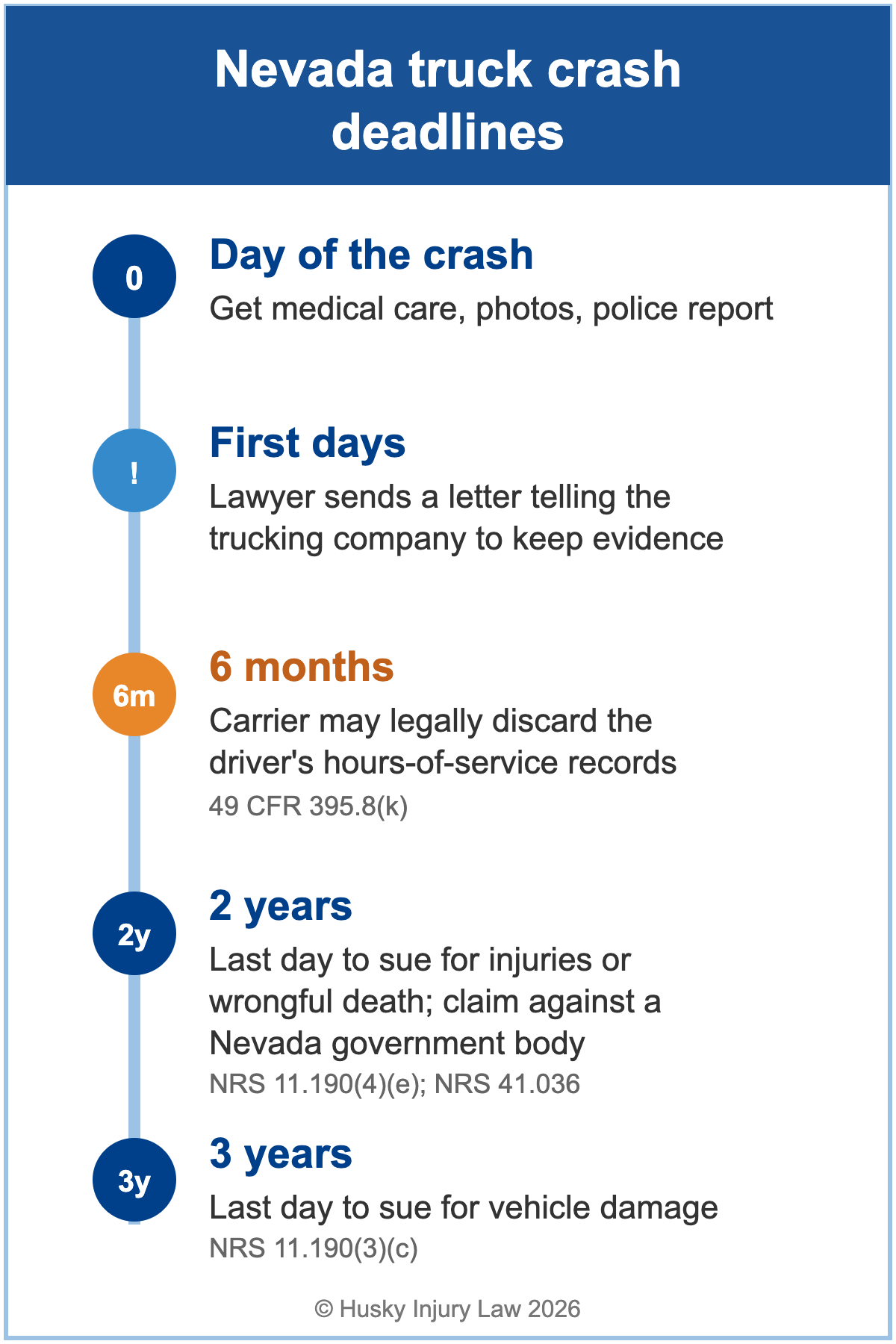
Claims against Nevada government bodies have special rules. The claim must be filed with the Attorney General (for the State) or the local governing body within 2 years,3 and Nevada caps damages at $200,000 per claimant with no punitive damages.4
Why naming every responsible party matters
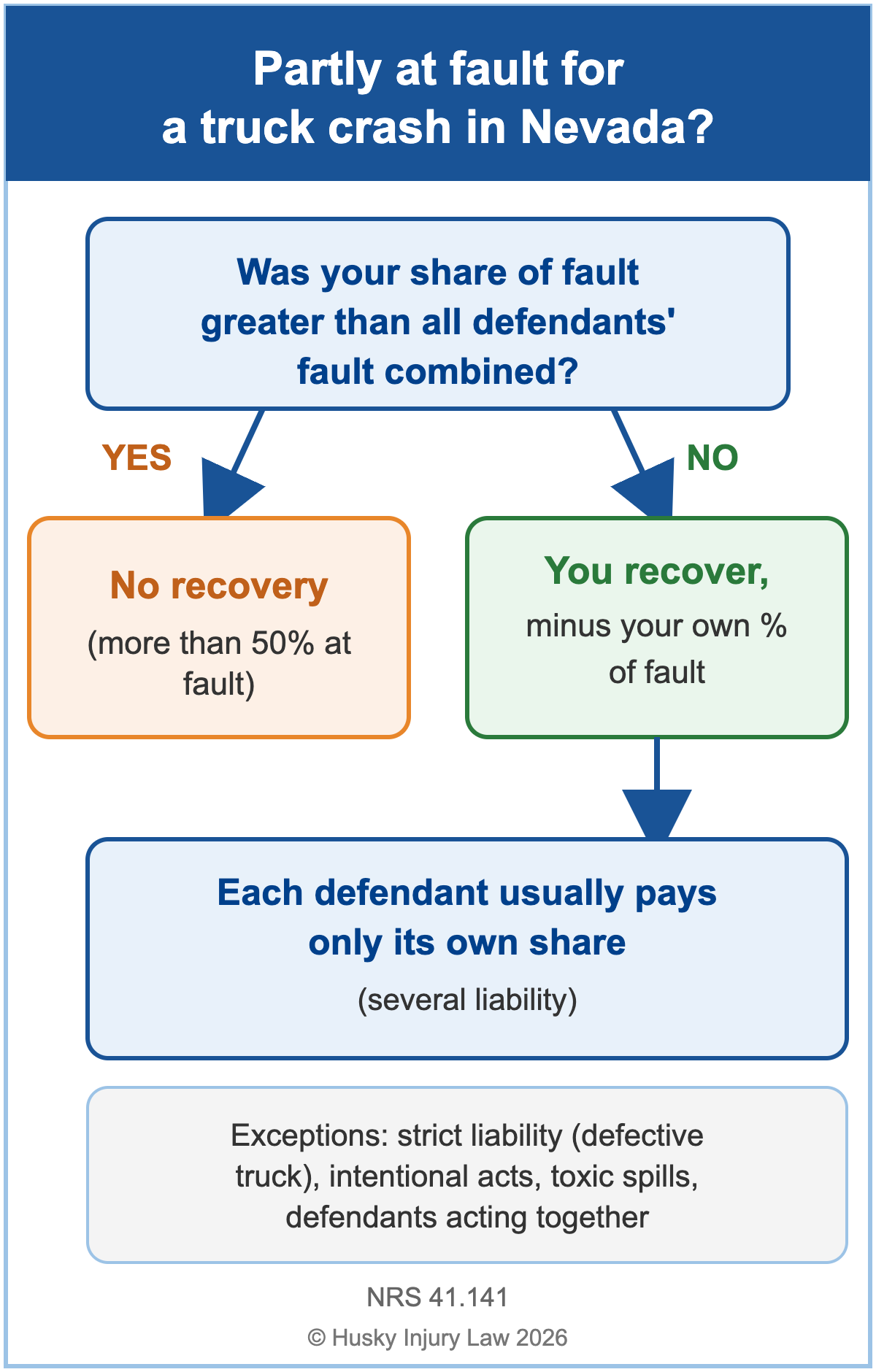
In most Nevada negligence cases, each defendant pays only its own percentage of the fault, not the whole judgment.5 If a responsible company is left out of the case, its share may go unpaid.
Example: Ana is rear-ended on I-15 in Las Vegas by a tractor-trailer. A jury awards her $500,000 and finds the driver’s employer 60% at fault and the freight broker 40% at fault (Ana 0%). The carrier pays $300,000 and the broker pays $200,000. If Ana had sued only the carrier, the broker’s $200,000 share would have been lost.
In our experience, the carrier, the broker and the maintenance shop often blame one another, which is why we investigate every company that touched the truck or its load.
3. What do I have to prove?
In Nevada, what you must prove depends on your legal claim; most truck cases rely on negligence, and many add claims against the employer or a manufacturer.
Nevada juries are instructed on each claim with the State Bar of Nevada’s pattern civil jury instructions. The elements below follow those instructions.
1) Negligence
To win a negligence claim in Nevada, you must prove that:6
- The defendant owed you a duty of care;
- The defendant breached that duty;
- The breach was the legal cause of your injuries; and
- You suffered damages.
The Nevada Supreme Court restated these same four elements in 2024 in PHWLV, LLC v. House of CB USA, LLC. A truck driver owes everyone on the road a duty to drive safely, so a driver who dozes off or checks a phone and causes a crash has breached that duty.
2) Negligence per se (breaking a safety law)
If a truck driver broke a traffic or safety law, Nevada treats the violation itself as negligence, as long as you are one of the people the law protects and your injury is the kind it was meant to prevent.7 You still have to show the violation caused your injuries.
For example, speeding, following too closely or driving with defective brakes can be negligence per se. The Nevada Supreme Court held in Brannan v. Nevada Rock & Sand Co. that a jury should have been instructed on negligence per se when a gravel truck’s poorly maintained brakes contributed to a crash with a motorcyclist.8
3) The trucking company’s liability for its driver
Under Nevada law, an employer is responsible for injuries its employee causes while doing the job. This is called respondeat superior or vicarious liability.9 You must show:
- The driver was the company’s employee;
- The driver was acting within the scope of the job when the crash happened; and
- The driver’s negligence caused your injuries.
Example: Marcus is delivering a load to a warehouse in North Las Vegas when he runs a red light and hits Teresa’s car. Because Marcus was on the job, his trucking company is liable for Teresa’s injuries along with Marcus.
Trucking companies carry far more insurance than individual drivers, so this claim is often where most of the compensation comes from.
4) Defective truck or parts (strict product liability)
If a defect such as a brake, tire or steering failure caused the crash, the manufacturer, distributor or seller may be liable even without proof of carelessness. In Nevada you must prove:10
- The defendant manufactured, distributed or sold the product;
- The product was defective;
- The defect existed when it left the defendant’s possession;
- The product was used in a reasonably foreseeable way; and
- The defect was a legal cause of your injury.
Learn more about strict liability in Nevada.
5) Wrongful death
If a truck crash kills someone, Nevada law lets the person’s heirs and the personal representative of the estate each bring a wrongful death lawsuit.11 Heirs can recover for their grief and sorrow, lost financial support and lost companionship. The estate can recover medical bills and funeral costs.
4. What federal trucking rules apply?
Most commercial trucks on Nevada highways must follow the Federal Motor Carrier Safety Regulations, and a violation can help prove the driver or carrier was negligent.
Hours-of-service limits
Federal rules limit how long a property-carrying truck driver may drive:12
- 10 hours off duty before starting to drive;
- 11 hours of driving at most in a shift;
- No driving after the 14th hour on duty;
- A 30-minute break after 8 hours of driving; and
- 60 hours in 7 days or 70 hours in 8 days, depending on the carrier’s schedule.
Driver logs and electronic logging devices (ELDs) show whether the driver broke these limits. A tired driver over the limit is a common sign of negligence by both the driver and the carrier.
Minimum insurance for trucking companies
Federal law requires for-hire interstate carriers to carry these minimum amounts of liability insurance (as of October 2026):13
| What the truck carries | Minimum coverage |
|---|---|
| General freight (non-hazardous), trucks 10,001 lbs or more | $750,000 |
| Oil and certain hazardous materials | $1,000,000 |
| Hazardous substances in bulk, certain explosives | $5,000,000 |
Many large carriers carry far more. These minimums are much higher than Nevada’s minimum for private cars, which is one reason truck cases are handled differently.
5. What evidence wins truck cases?
In a Nevada truck case, the strongest evidence is usually the truck’s own data and the carrier’s records, and some of it can be legally discarded within months.
Evidence your lawyer will look for
- Engine control module (ECM) data: the truck’s “black box,” which can show speed, braking and throttle in the seconds before the crash.
- ELD and hours-of-service records: show how long the driver had been driving.
- Driver qualification file: licensing, medical certificate, past violations and drug and alcohol tests.
- Maintenance and inspection records: brakes, tires, lights.
- Load and shipping records: cargo weight and who loaded it.
- Dash cameras, phone records and witness statements.

Why you need to act within months
Federal rules only require trucking companies to keep a driver’s hours-of-service records and supporting documents for 6 months.14 That’s why your lawyer should send a preservation letter (a written demand to keep all evidence) as soon as possible.
Once a lawsuit is pending or reasonably foreseeable, a company has a duty to preserve evidence it should know is relevant.15 The Nevada Supreme Court applied that rule to a trucking company that threw away replaced parts after a crash in MDB Trucking, LLC v. Versa Products Co. If evidence is willfully suppressed, Nevada law presumes it would have hurt the party that hid it.16
Example: Luis waits 8 months after a crash on US-95 to contact a lawyer. By then the carrier has lawfully discarded the driver’s duty-status records, and proving the driver was over his hours becomes much harder.
6. What damages can I recover?
In a Nevada truck accident lawsuit you can recover compensatory damages for all your losses, and in rare cases punitive damages.
Compensatory damages
These may include:
- Medical bills, past and future, including rehab and home care;
- Lost wages and lost earning capacity;
- Pain and suffering and emotional distress;
- Vehicle repair or replacement and other property damage; and
- In a death case, funeral costs, lost support and the family’s grief (see section 3).
Truck crashes often cause serious injuries such as brain injuries, spinal injuries and burns, which drive damages higher. See our guide to damages in Nevada injury cases.
Punitive damages
In Nevada, a jury may award punitive damages only if you prove by clear and convincing evidence that the defendant acted with oppression, fraud or malice, such as a conscious disregard of others’ safety. Punitive damages are usually capped at 3 times compensatory damages (if those are $100,000 or more) or $300,000 (if less), but the cap does not apply to the maker or seller of a defective product.17
A trucking company pays punitive damages for its driver’s conduct only if it knew the driver was unfit and hired or kept the driver anyway, authorized or ratified the conduct, or was itself guilty of oppression, fraud or malice.18
Example: A carrier keeps dispatching a driver it knows has failed two drug tests, and he causes a crash while impaired. Because the carrier knew he was unfit and kept him on the road, the jury may award punitive damages against the carrier as well as the driver.
7. How long do I have to sue?
In Nevada, you generally have 2 years from the date of a truck crash to sue for injuries or wrongful death, and 3 years to sue for vehicle damage.
- Injury or death: 2 years.19
- Property damage: 3 years.20
- Claims against a Nevada government body: a written claim within 2 years (see section 2).
Some exceptions can extend these deadlines, for example for children. A lawyer can tell you which deadline applies, but waiting puts evidence at risk long before the deadline passes. See our page on Nevada’s statute of limitations and truck accident deadlines.
8. What if I was partly at fault?
Under Nevada’s modified comparative negligence rule, you can still recover if your share of the fault was not greater than the combined fault of the defendants, but your award is reduced by your percentage.
This rule comes from NRS 41.141.21 The jury decides each party’s percentage of fault.
Example: Lily is driving 10 mph over the limit on Tropicana Avenue when a box truck runs a red light and hits her. The jury finds the truck driver 70% at fault and Lily 30% at fault, and values her losses at $200,000. Lily recovers $140,000. If Lily had been found 51% at fault, she would recover nothing.
See also our page on comparative negligence in Nevada.
9. How do trucking companies fight back?
Trucking companies and their insurers usually defend Nevada truck cases by shifting blame, to you or to another company.
Common defenses include:
- Blaming you: claiming you were speeding, cut off the truck or were distracted, to reduce your award under the comparative-fault rule;
- Blaming each other: the carrier blames the maintenance shop, the shop blames the parts maker, and so on;
- “Off duty” arguments: claiming the driver was outside the scope of the job, to avoid employer liability;
- Disputing your injuries: arguing your injuries were pre-existing or not as serious as claimed.
We often see insurers make a quick, low offer before the victim knows the full extent of the injuries. One thing we’ve found is that the truck’s own data and logs are usually the best answer to these defenses.
10. What causes truck crashes?
Federal research found that when a large truck caused a serious crash, the truck driver’s own error was the reason most of the time.
In the federal Large Truck Crash Causation Study, when the truck was assigned the critical reason for the crash, 87% of the time it was the driver: 38% were decision errors such as driving too fast for conditions, 28% recognition errors such as inattention, and 12% non-performance such as falling asleep. The most common factors found in the trucks studied were brake problems (29%) and traveling too fast for conditions (23%); fatigue was found in 13%.22
Each cause points to different evidence:
- Fatigue: hours-of-service logs and ELD data;
- Speed or hard braking: ECM data;
- Brake or tire failure: maintenance and inspection records;
- Distraction: phone records and in-cab cameras.
How common truck crashes are
In 2023, 5,472 people were killed and about 153,452 were injured in U.S. crashes involving large trucks; 70% of those killed were in other vehicles. In Nevada, 56 people died in crashes involving large trucks that year.23

11. Truck accident lawsuit FAQ
How long does a truck accident lawsuit take in Nevada?
Many Nevada truck accident claims settle within several months to a year, but a lawsuit that goes through discovery and trial can take two years or more. Serious injuries and multiple defendants usually make a case take longer.
How much are truck accident settlements in Nevada?
There is no typical amount: a Nevada truck accident settlement depends on your medical bills, lost income, pain and suffering, who was at fault and how much insurance the defendants carry. Federal rules require most interstate carriers to carry at least $750,000 in liability coverage.
Can I sue both the trucking company and the driver?
Yes. In Nevada you can sue the driver and the trucking company together, and the company is generally liable for a crash its employee caused while on the job.
How long do I have to file a truck accident lawsuit in Nevada?
Generally 2 years from the crash for injuries or wrongful death, and 3 years for vehicle damage under NRS 11.190. Claims against a Nevada government body have their own filing rules.
What if I was partly at fault for the truck crash?
Under Nevada’s comparative negligence rule (NRS 41.141), you can still recover as long as your fault was not greater than the defendants’ combined fault, but your award is reduced by your percentage of fault.
Hurt in a truck crash in Las Vegas or elsewhere in Nevada? Call us
If you or a loved one was injured in a crash with a semi-truck or commercial vehicle in Nevada, our Las Vegas truck accident lawyers and Henderson truck accident lawyers can investigate the crash, preserve the evidence and pursue every responsible company. Contact us for a free consultation. We also handle tractor-trailer accident lawsuits throughout Nevada.
Legal references:
- Nevada Jury Instructions: Civil 2.1 (State Bar of Nevada, 2018 ed.): a preponderance of the evidence is evidence that “is more probably true than not true.”
- NRS 41.130: “… where the person causing the injury is employed by another person or corporation responsible for the conduct of the person causing the injury, that other person or corporation so responsible is liable to the person injured for damages.”
- NRS 41.036 (tort claims against the State are filed with the Attorney General; claims against a political subdivision with its governing body, within 2 years after the claim accrues).
- NRS 41.035(1): an award “may not exceed the sum of $200,000 … to or for the benefit of any claimant. An award may not include any amount as exemplary or punitive damages.”
- NRS 41.141(4)-(5): “… each defendant is severally liable to the plaintiff only for that portion of the judgment which represents the percentage of negligence attributable to that defendant.” Subsection 5 keeps joint and several liability for strict liability, intentional torts, toxic or hazardous spills, concerted acts and certain product cases.
- Nevada Jury Instructions: Civil 4.2 (2018 ed.): “To prevail on a negligence claim, a plaintiff must establish that (1) the defendant owed the plaintiff a duty of care, (2) the defendant breached that duty, (3) the breach was the legal cause of the plaintiff’s injuries, and (4) the plaintiff suffered damages.”; PHWLV, LLC v. House of CB USA, LLC, 140 Nev. 481, 483, 554 P.3d 715, 719 (2024) (same four elements, quoting Turner v. Mandalay Sports Entm’t, LLC, 124 Nev. 213, 217, 180 P.3d 1172, 1175 (2008)).
- Nevada Jury Instructions: Civil 4.13 (2018 ed.): “A violation of the law[s] just read to you constitutes negligence as a matter of law.”; Atkinson v. MGM Grand Hotel, Inc., 120 Nev. 639, 641-42, 98 P.3d 678, 679-80 (2004); Vega v. Eastern Courtyard Assocs., 117 Nev. 436, 24 P.3d 219 (2001) (the injured person must belong to the class the law protects, and the injury must be the type it was meant to prevent).
- Brannan v. Nevada Rock & Sand Co., 108 Nev. 23, 823 P.2d 291 (1992) (motorcycle-truck collision; the jury should have been instructed on negligence per se for the truck’s poorly maintained brakes).
- Nevada Jury Instructions: Civil 15.3 (2018 ed.) (an organization acts only through its agents, officers and employees and is responsible for harm they cause within the scope of their authority).
- Nevada Jury Instructions: Civil 7.1 (2018 ed.) (elements of strict product liability); Allison v. Merck & Co., 110 Nev. 762, 767, 878 P.2d 948, 952 (1994).
- NRS 41.085(2), (4)-(5): heirs may recover “pecuniary damages for the person’s grief or sorrow, loss of probable support, companionship, society, comfort and consortium, and damages for pain, suffering or disfigurement of the decedent”; the personal representative may recover special damages such as medical and funeral expenses. See also Nevada Jury Instructions: Civil 5.5 (2018 ed.).
- 49 C.F.R. § 395.3 (10 consecutive hours off duty before driving; no driving after the 14th hour on duty; 11 hours of driving; 30-minute break after 8 hours of driving; 60 hours in 7 days or 70 hours in 8 days).
- 49 C.F.R. § 387.9, Table 1 (as of October 2026): $750,000 for for-hire carriers of non-hazardous property in vehicles of 10,001 pounds or more; $1,000,000 for oil and certain hazardous materials; $5,000,000 for hazardous substances in bulk and certain explosives.
- 49 C.F.R. § 395.8(k)(1): “A motor carrier shall retain records of duty status and supporting documents … for a period of not less than 6 months from the date of receipt.”
- MDB Trucking, LLC v. Versa Products Co., 136 Nev. 626, 636, 475 P.3d 397 (2020): “A party has a duty to preserve evidence ‘which it knows or reasonably should know is relevant’ … to litigation that is pending or reasonably foreseeable.”
- NRS 47.250(3): a disputable presumption “That evidence willfully suppressed would be adverse if produced.”
- NRS 42.005(1)-(2): punitive damages require proof “by clear and convincing evidence that the defendant has been guilty of oppression, fraud or malice” and may not exceed “(a) Three times the amount of compensatory damages … if the amount of compensatory damages is $100,000 or more; or (b) Three hundred thousand dollars” if less; the limits do not apply to “(a) A manufacturer, distributor or seller of a defective product.” See also Nevada Jury Instructions: Civil 12.1 (2018 ed.).
- NRS 42.007(1): the employer is not liable for punitive damages for its employee’s wrongful act unless “(a) The employer had advance knowledge that the employee was unfit … and employed the employee with a conscious disregard of the rights or safety of others; (b) The employer expressly authorized or ratified the wrongful act …; or (c) The employer is personally guilty of oppression, fraud or malice.” See also Nevada Jury Instructions: Civil 12.2 (2018 ed.).
- NRS 11.190(4)(e): “Within 2 years: … an action to recover damages for injuries to a person or for the death of a person caused by the wrongful act or neglect of another.”
- NRS 11.190(3)(c): “Within 3 years: … An action for taking, detaining or injuring personal property ….”
- NRS 41.141(1): “… the comparative negligence of the plaintiff … does not bar a recovery if that negligence was not greater than the negligence or gross negligence of the parties to the action against whom recovery is sought.” See also Nevada Jury Instructions: Civil 4.8 (2018 ed.).
- Federal Motor Carrier Safety Administration, The Large Truck Crash Causation Study – Analysis Brief (FMCSA-RRA-07-017, July 2007), Tables 1-2.
- National Highway Traffic Safety Administration, Large Trucks: 2023 Data (DOT HS 813 717, April 2025): “In 2023 there were 5,472 people killed and an estimated 153,452 people injured in traffic crashes involving large trucks”; Table 7 (Nevada: 56 people killed).