
Quick summary
In Nevada, you can bring a gym injury lawsuit in Las Vegas when the gym’s negligence, an employee’s misconduct or a defective machine causes your injury. You can recover your medical bills, lost income and pain and suffering.
- Who you can sue: The gym, a trainer or other employee, the maker or seller of a defective machine, and sometimes another member.
- Waivers: A signed waiver can block some claims, but no published Nevada opinion has yet decided how far a gym waiver reaches.
- Deadline: You generally have 2 years from the injury to sue (NRS 11.190).
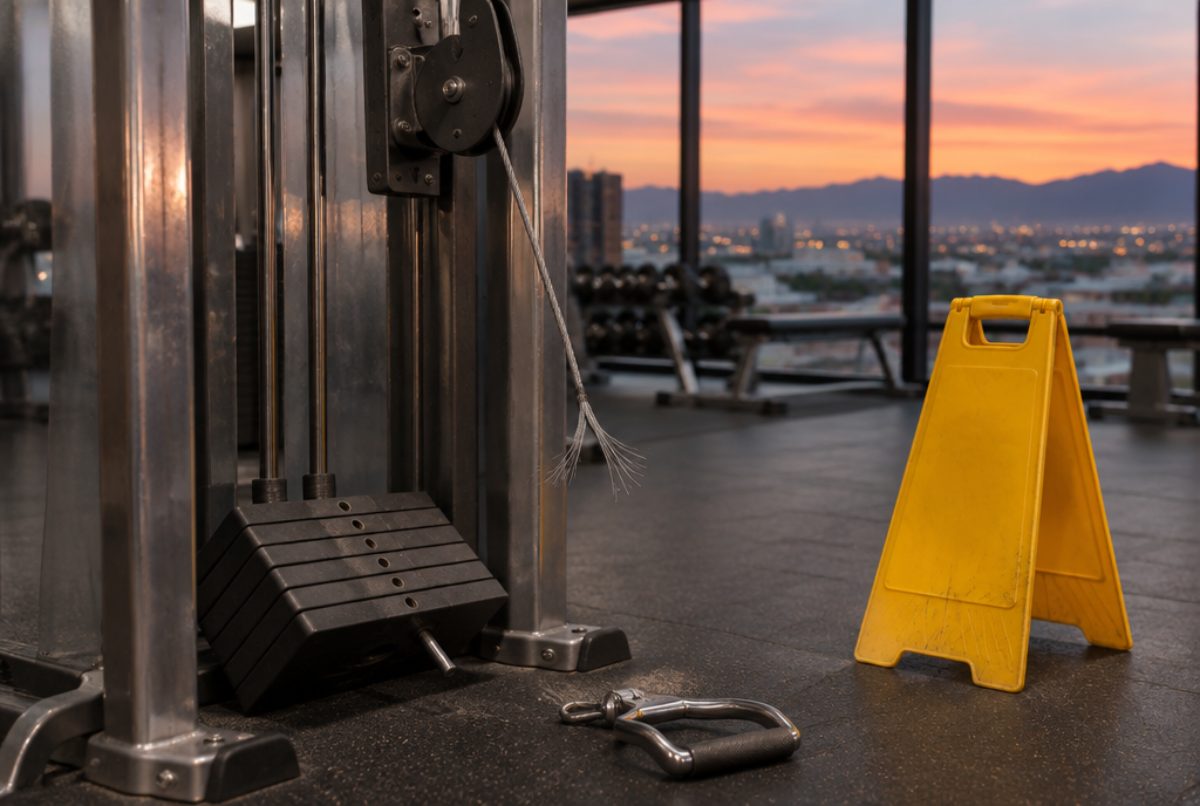
- Example: A cable snaps on a Henderson gym’s cable machine and the handle strikes Ana’s face. She may have claims against the gym for poor maintenance and against the machine’s maker for a defect.
In this article, our Nevada personal injury attorneys answer 8 common questions about suing a gym or fitness center in Las Vegas:
- 1. Can I sue a Las Vegas gym for an injury?
- 2. Does the waiver I signed stop me from suing?
- 3. Who can be liable for a gym injury?
- 4. What do I have to prove?
- 5. How long do I have to sue, and what should I do first?
- 6. What can I recover?
- 7. What if I was partly at fault?
- 8. FAQ
1. Can I sue a Las Vegas gym for an injury?
Yes. In Nevada, a gym, like any business, owes its members and guests a duty of reasonable care. You can sue when a gym or its staff is careless and that carelessness injures you.1
Gym injury lawsuits in Las Vegas usually arise from:
- Poorly maintained equipment, such as frayed cables, worn belts or loose bolts
- Defective machines that were badly designed or built
- Slippery floors in spin rooms, locker rooms, showers and pool decks
- Trainer mistakes, such as pushing a client past safe limits or ignoring a known injury
- Assaults or misconduct by staff or other members
- Poor supervision of pools, saunas, climbing walls and group classes
Common gym injuries include broken bones, torn ligaments, brain injuries and spinal injuries. Gym injury claims are a type of premises liability case.

2. Does the waiver I signed stop me from suing?
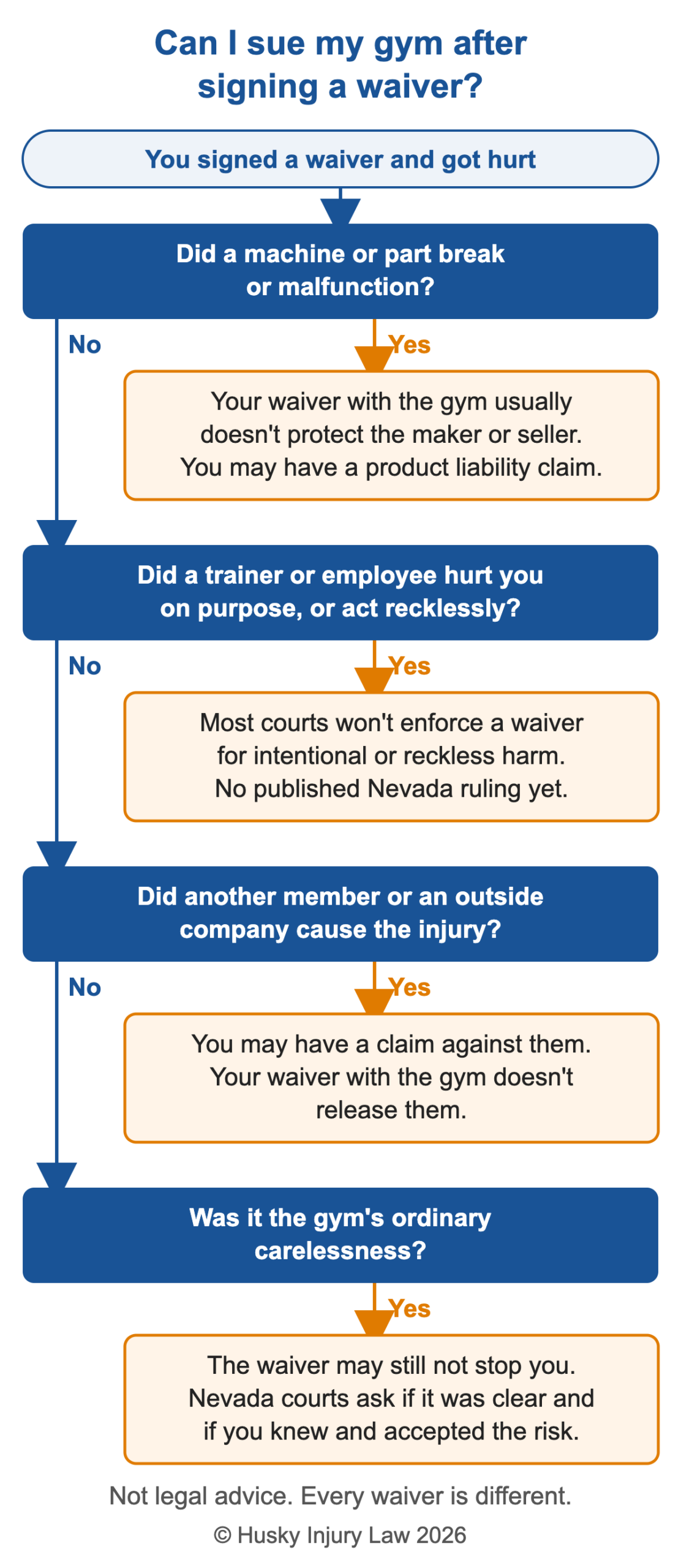
Not always. In Nevada, a signed liability waiver is a form of “express assumption of risk”: you agreed ahead of time not to hold the gym responsible for a known risk. If you specifically agreed to that, you may not recover for an injury caused by that risk.2 Nevada still allows this defense because it comes from a contract.3
But a waiver does not end the case automatically. The Nevada Supreme Court has held that a signed release did not, by itself, prove that the signer assumed the risk. The gym must show you actually knew the risk you were giving up. Facts such as how hastily the release was signed and what the parties understood matter.4
No published Nevada appellate opinion has yet ruled on a gym or health-club waiver.5 Most courts in other states refuse to enforce waivers for gross negligence, reckless or intentional harm, or defective products. Those limits are widely recognized but not yet decided in a published Nevada opinion.
Your waiver may also not reach:
- Intentional harm, such as an assault by a trainer
- Defective machines: a waiver signed with the gym usually doesn’t protect the company that made or sold the machine
- Other people, such as another member who hurt you
- Risks it doesn’t clearly describe, or risks you didn’t know about
Read more about assumption of risk in Nevada.
Example: Marcus signs a membership agreement with a waiver at a Summerlin gym. Months later, a trainer angrily shoves him off a bench. The waiver almost certainly doesn’t cover an intentional shove, and Marcus may sue the trainer and possibly the gym.
3. Who can be liable for a gym injury?
The gym, for its employees’ carelessness
In Nevada, an employer is liable when its employee carelessly injures someone while doing the job.6 So if a staff member leaves a weight on the floor during a shift and you trip on it, the gym can be liable.
Example: Dan, a gym employee, is wiping down machines during his shift. He leaves a spray bottle on the treadmill belt, and a member trips on it when she starts the machine. The gym is responsible for Dan’s carelessness.
The gym, for a trainer’s or employee’s intentional misconduct
Under NRS 41.745, a Nevada employer can be liable even for an employee’s intentional wrongdoing, such as an assault. It escapes liability only if the act was a truly independent venture, was not committed in the course of the employee’s assigned task, and was not reasonably foreseeable.7
Whether the act was foreseeable is often for the jury. In a 2015 case, the Nevada Supreme Court held that a jury could find a hotel employee’s sexual assault of a guest reasonably foreseeable.8 But an employer is not liable where nothing made the assault foreseeable.9
This matters for personal trainers, who work closely with clients. A trainer who touches a client inappropriately, or who forces a client through a dangerous exercise, may make both the trainer and the gym liable.
Example: Ben, a gym employee, hides a camera in the women’s locker room. Taking such images is a crime in Nevada.10 The members he recorded can sue Ben for invasion of privacy. They may also sue the gym under NRS 41.745 or for negligent supervision.
The gym, for careless hiring, training and supervision
A Nevada employer has a duty to do a reasonable background check before hiring and to use reasonable care in training, supervising and keeping its employees.11 A gym that hires a trainer with a history of assaulting clients, or keeps one after complaints, may be liable for negligent hiring, retention or supervision.
The maker or seller of a defective machine
Nevada holds makers, distributors and sellers of defective products strictly liable. You don’t have to prove they were careless, only that the product was defective and caused your injury.12 A product can be defective in three ways:13
- Design defect: the whole product line is unsafe, such as a bench that tips under its rated load
- Manufacturing defect: one unit came off the line flawed, such as a badly crimped cable
- Warning defect: the product lacked adequate instructions or warnings
In product liability cases, each responsible defendant can be made to pay all your damages, not just its share.14
Other members, and hotel and casino gyms
A gym is not usually liable when another member hurts you. You can sue that member directly. The gym may share the blame if it ignored warnings about the member or failed to keep order.
If you were hurt at a Las Vegas hotel or casino gym by another guest, NRS 651.015 applies. The hotel is liable only if the attack was foreseeable and it failed to use due care. An attack counts as foreseeable if the hotel failed to use due care for guests’ safety, or if similar incidents had happened there before and the hotel knew of them.15
Discrimination at a gym
Nevada treats gyms and health spas as public accommodations. Under NRS 651.070, they may not discriminate based on race, color, religion, national origin, disability, sexual orientation, sex, or gender identity or expression. You can bring a civil action for a violation.16
4. What do I have to prove?
To win a Nevada gym injury case based on negligence, you generally must prove that:17
- The gym owed you a duty of reasonable care;
- The gym breached that duty, for example by failing to inspect, repair or warn;
- The breach caused your injury; and
- You suffered damages.
Wet floors and spills
When a member spills water or leaves a puddle, the gym is usually liable only if it knew, or should have known, about the hazard and failed to fix it.18 A hazard that keeps recurring can be enough to show the gym should have known. See our page on slip-and-fall lawsuits.
Nevada also recognizes a “mode of operation” rule. When a business’s chosen way of operating makes a dangerous condition reasonably foreseeable, it can be liable if it failed to take all reasonable precautions, even without notice of the specific puddle. The Nevada Supreme Court has applied this to self-service businesses, but not generally to sit-down restaurants.19 A gym where members sweat on shared machines, or a spin room where sweat pools on the floor, is arguably similar. No published Nevada opinion has applied the rule to a gym yet.
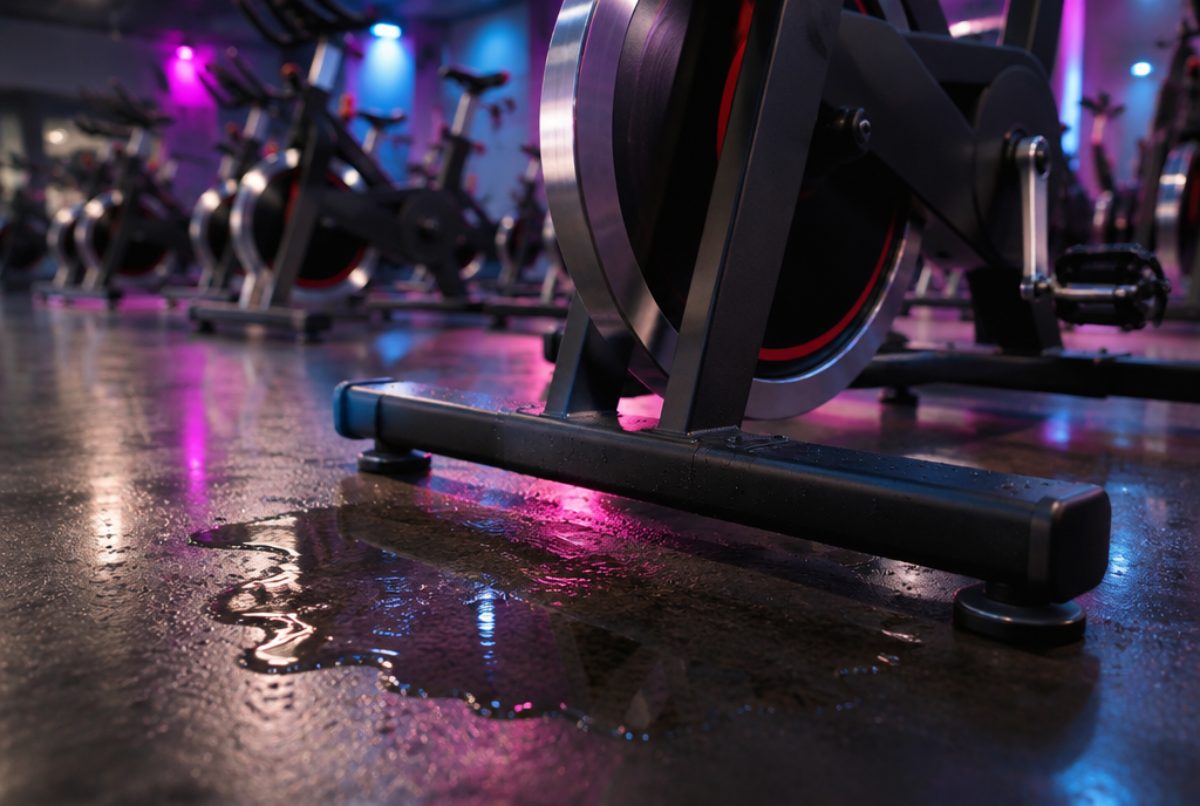
Example: Priya slips on a pool of sweat as she gets off a bike after a spin class. The studio uses no floor mats and never wipes the floor between back-to-back classes. Even if no one saw that puddle, Priya can argue the studio’s setup made wet floors foreseeable.
Obvious dangers
A gym can’t escape liability just because a hazard was obvious. The Nevada Supreme Court has held that an obvious danger doesn’t automatically relieve a business of its duty of reasonable care. Instead, it goes to how much of the fault is yours.20
5. How long do I have to sue, and what should I do first?
In Nevada, you generally have 2 years from the date of your injury to file a personal injury lawsuit.21 If you miss this statute of limitations, you will likely lose your claim.
After a gym injury in Las Vegas:
- Get medical care right away, and keep every record and bill.
- Report the injury to the gym and ask for a copy of the incident report.
- Take photos of the machine, floor or area, and of your injuries.
- Get names of staff and witnesses.
- Keep your membership agreement and any waiver you signed.
- Ask the gym in writing to keep its video. Many systems record over footage after a few weeks.
- Don’t throw out broken equipment parts, shoes or clothing.
6. What can I recover?
In a Nevada gym injury case, you can seek:
- Medical bills, past and future
- Lost wages and lost earning capacity
- Pain and suffering
- Damages for emotional distress
- Punitive damages, but only with clear and convincing proof of oppression, fraud or malice. Extra conditions apply against an employer.22
Nevada generally does not award attorney’s fees to the winner unless a statute, rule or contract allows them.23 If a gym injury causes a death, the family may bring a separate wrongful death claim.24
7. What if I was partly at fault?
You can still recover in Nevada as long as your share of the fault is not greater than the combined fault of the defendants. Your award is reduced by your percentage of fault. In most negligence cases, each defendant pays only its own share.25 See comparative negligence in Nevada.
Example: Lou is hurt when a treadmill belt the gym knew was slipping jerks to a stop. The jury finds Lou 20% at fault for not using the safety clip and the gym 80% at fault. If his damages are $100,000, he recovers $80,000.
Nevada’s comparative-fault statute compares negligence. Its rule that each defendant pays only its own share does not apply to intentional harm, such as an assault by a trainer.26
8. FAQ
Can I sue my gym if I signed a waiver in Nevada?
Often, yes. A Nevada gym waiver can block some negligence claims, but the gym must show you knowingly accepted the risk. No published Nevada opinion has yet decided whether a gym waiver covers gross negligence, intentional harm or defective equipment.
How long do I have to sue a gym in Nevada?
Generally 2 years from the date of the injury under NRS 11.190. Act sooner so the gym’s video and records are still available.
Can I sue my gym if a personal trainer hurt me?
Yes. You can sue the trainer, and the gym is usually liable for a trainer employee’s carelessness. Under NRS 41.745, the gym can even be liable for a trainer’s intentional misconduct if it was reasonably foreseeable.
Can I sue if another gym member hurt me?
You can sue the member. The gym is usually not liable unless it ignored warnings or failed to keep order. At a Las Vegas hotel gym, NRS 651.015 requires that the attack was foreseeable.
What if a gym machine broke and injured me?
You may have claims against the gym for poor maintenance and against the machine’s maker, distributor or seller for a defect. Nevada holds sellers of defective products strictly liable.
Can I sue a hotel or casino gym in Las Vegas?
Yes. A hotel gym owes guests reasonable care like any gym. If another guest attacked you, NRS 651.015 limits the hotel’s liability to foreseeable attacks.
Hurt at a gym in Las Vegas? Our Nevada personal injury attorneys offer a free consultation, and we take cases on contingency, so there is no fee unless we win. Contact Husky Injury Law today.
Legal references:
- Nevada Jury Instructions: Civil 8.1 and 8.4 (State Bar of Nevada, 2018 ed.).
- Nevada Jury Instructions: Civil 4.17 (Express Assumption of Risk) (State Bar of Nevada, 2018 ed.).
- Turner v. Mandalay Sports Entm’t, LLC, 124 Nev. 213, 220, 180 P.3d 1172, 1177 (2008) (express assumption of risk remains a defense in Nevada because it stems from a contractual undertaking).
- Renaud v. 200 Convention Ctr. Ltd., 102 Nev. 500, 501–02, 728 P.2d 445 (1986): “actual knowledge of the risks assumed is an essential element of this defense.”
- “The Enforceability of Fitness Club Waivers,” Nevada Lawyer (Aug. 2018).
- NRS 41.130. See also Nevada Jury Instructions: Civil 15.3 (State Bar of Nevada, 2018 ed.).
- NRS 41.745(1): an employer is not liable only if the employee’s conduct was a truly independent venture, was not committed in the course of the very task assigned, and was not reasonably foreseeable.
- Anderson v. Mandalay Corp., 131 Nev. 825, 358 P.3d 242 (2015): “a reasonable jury could find that the employee’s criminal conduct was reasonably foreseeable.”
- Wood v. Safeway, Inc., 121 Nev. 724, 121 P.3d 1026 (2005) (no employer liability where the assault was not reasonably foreseeable).
- NRS 200.604 (capturing an image of another person’s private area without consent).
- Hall v. SSF, Inc., 112 Nev. 1384, 930 P.2d 94 (1996): the employer has a duty to use reasonable care in the training, supervision and retention of employees.
- Shoshone Coca-Cola Bottling Co. v. Dolinski, 82 Nev. 439, 420 P.2d 855 (1966). See also Nevada Jury Instructions: Civil 7.1 (State Bar of Nevada, 2018 ed.).
- Nevada Jury Instructions: Civil 7.2 (design defect), 7.3 (manufacturing defect) and 7.4 (warning defect) (State Bar of Nevada, 2018 ed.).
- NRS 41.141(5) (joint and several liability is preserved in actions based on strict liability, intentional torts and products liability, among others).
- NRS 651.015: a hotel owner is not liable for injury caused by a non-employee unless the wrongful act was foreseeable and the owner failed to use due care; an act is foreseeable only if the owner failed to exercise due care or prior similar incidents occurred on the premises and the owner knew of them.
- NRS 651.050(2)(m) (“Any gymnasium, health spa … or other place of exercise or recreation”); NRS 651.070; NRS 651.090.
- Nevada Jury Instructions: Civil 8.1 and 8.4 (State Bar of Nevada, 2018 ed.) (see note 1 above).
- Nevada Jury Instructions: Civil 8.5 (State Bar of Nevada, 2018 ed.); Sprague v. Lucky Stores, Inc., 109 Nev. 247, 250–51, 849 P.2d 320 (1993) (“the virtually continual debris on the produce department floor put Lucky on constructive notice”).
- Nevada Jury Instructions: Civil 8.6 and use note (State Bar of Nevada, 2018 ed.); FGA, Inc. v. Giglio, 128 Nev. 271, 278 P.3d 490, 496 (2012) (mode-of-operation liability applies to self-service settings and “does not generally extend to a sit-down restaurant”).
- Foster v. Costco Wholesale Corp., 128 Nev. 773, 291 P.3d 150 (2012): “the open and obvious nature of a dangerous condition does not automatically relieve a landowner from the general duty of reasonable care.”
- NRS 11.190(4)(e).
- NRS 42.005; NRS 42.007 (employer liability for punitive damages). See also Nevada Jury Instructions: Civil 12.1–12.2 (State Bar of Nevada, 2018 ed.).
- NRS 18.010 (attorney’s fees allowed only in listed situations); see, e.g., NRS 651.090.
- NRS 41.085.
- NRS 41.141(1)–(4). See also Nevada Jury Instructions: Civil 4.8 (State Bar of Nevada, 2018 ed.).
- NRS 41.141(5) (see note 14 above).