
Quick summary
Nevada dog bite law has no strict-liability statute, so a dog owner is not automatically responsible for every bite. You can still recover compensation in Nevada if the owner knew the dog was dangerous, broke a local leash law, or failed to use reasonable care, and NRS 202.500 sets the state’s rules for “dangerous” and “vicious” dogs.
- Dangerous dogs: One minor bite doesn’t make a dog “dangerous” or “vicious” in Nevada; that takes 2 menacing incidents in 18 months, or a killing or serious injury.
- Leash laws: A dog loose against a Las Vegas, Henderson or Clark County leash law can make the owner liable, even with no history of aggression.
- Your own fault: You can recover if your share of the fault isn’t greater than the owner’s; your award is reduced by your percentage.
- Deadline: You generally have 2 years from the bite to file a lawsuit; for a child, the 2 years usually start at age 18.
In this article, our Las Vegas dog bite lawyers answer 13 common questions about Nevada dog bite laws:
- 1. Does Nevada have a dog bite law?
- 2. What is Nevada’s one-bite rule?
- 3. When is a dog owner negligent?
- 4. Leash laws and negligence per se
- 5. Dangerous vs. vicious dogs (NRS 202.500)
- 6. Can I sue the landlord or property owner?
- 7. What if I was partly at fault?
- 8. What compensation can I get?
- 9. Reporting a bite and quarantine in Clark County
- 10. Dogs on the Las Vegas Strip
- 11. How long do I have to file?
- 12. What to do after a dog bite in Las Vegas
- 13. Frequently asked questions
1. Does Nevada have a dog bite law?
In Nevada, there is no civil statute that makes a dog owner automatically liable for a bite. Many states have “strict liability” dog bite laws; Nevada does not. Instead, you hold the owner responsible in one of three ways:
- The one-bite (knowledge) rule: the owner knew or should have known the dog could be dangerous (section 2).
- Negligence: the owner failed to use reasonable care to control the dog (section 3).
- Negligence per se: the owner broke a law meant to prevent dog attacks, such as a leash law (section 4).
In some cases a landlord, business or other person who took on control of the dog can also be liable (section 6).

2. What is Nevada’s one-bite rule?
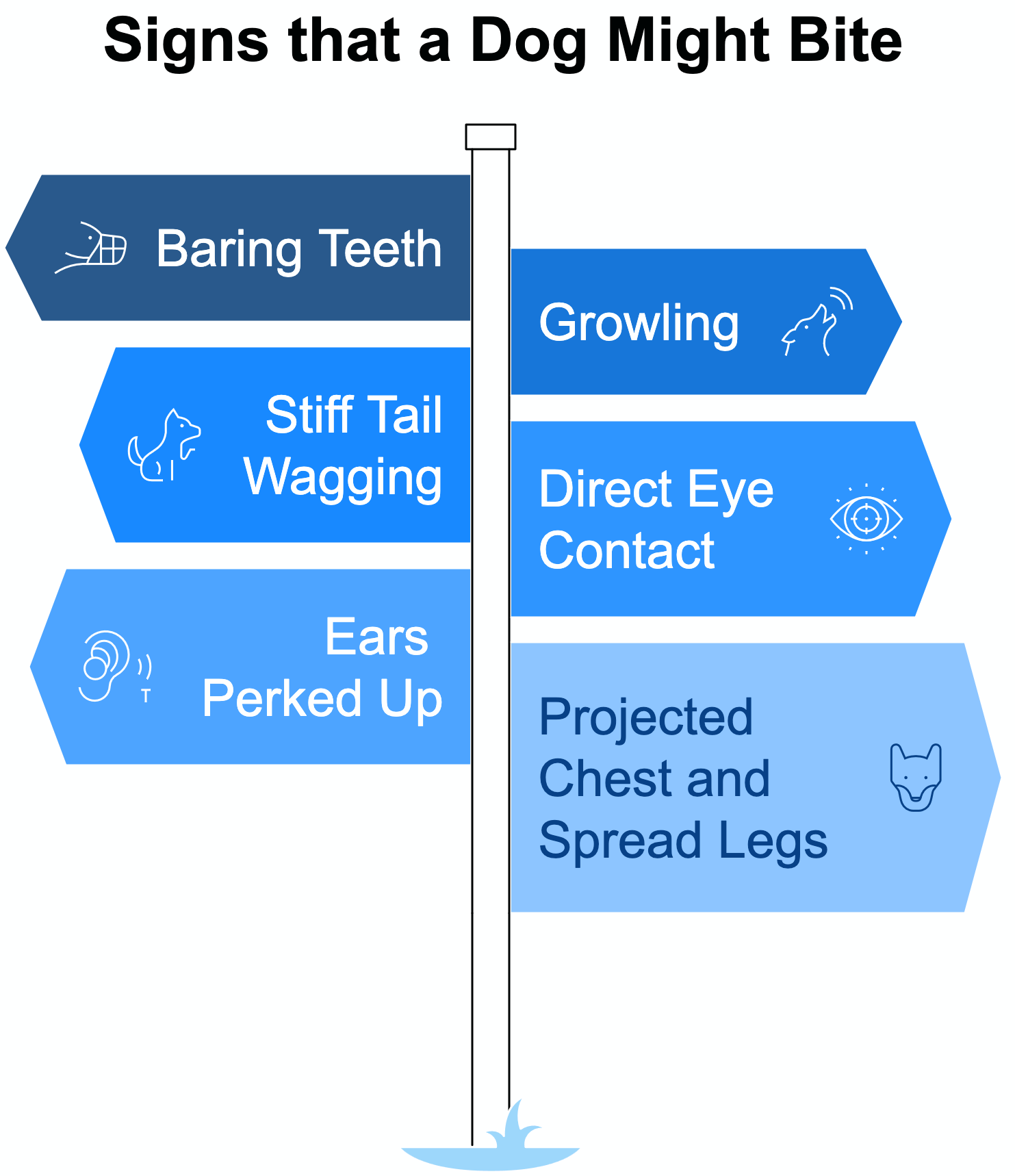
In Nevada, the “one-bite rule” means a dog owner is liable if they knew, or reasonably should have known, that the dog had a dangerous tendency. Despite the name, the dog does not need to have bitten someone before. Earlier lunging, snapping, growling at people, or attacks on other animals can show the owner was on notice.
What counts as notice of a dangerous dog
Evidence that often shows an owner knew about the risk includes:
- Prior incidents: earlier bites, attacks or menacing behavior toward people or pets.
- Complaints: neighbors’ complaints, animal control visits or a dangerous-dog finding.
- The owner’s own actions: a “Beware of Dog” sign, a muzzle, or warnings to visitors can show the owner knew the dog was a danger.
In our experience handling Las Vegas dog bite claims, the owner’s neighbors and mail carriers are often the best witnesses to a dog’s past behavior.
Example: Dana’s neighbor in Summerlin has a dog that has lunged at people over the fence several times, and the neighbor has apologized for it. When the dog gets out and bites Dana, the neighbor’s knowledge of those earlier incidents supports a claim under the one-bite rule.
3. When is a dog owner negligent?
In Nevada, a dog owner is negligent if they fail to use the care a reasonable person would use to keep the dog from hurting someone. To win a negligence claim, you must prove four things:1
- Duty: the owner had a duty to use reasonable care.
- Breach: the owner failed to use that care, for example by leaving a gate open or walking a strong dog they couldn’t hold.
- Legal cause: the failure caused your injury.
- Damages: you were actually harmed.
Clark County’s 2025 rule on dog attacks
Since February 2025, Clark County Code 10.36.050 makes it a violation when a dog attacks and injures someone who did not provoke it and the owner failed to use reasonable care.2 The minimum fine is $500. This is a county code violation, separate from your injury claim, but it shows the county treats an owner’s carelessness that leads to an attack as unlawful.
One thing we’ve found in Las Vegas dog bite cases: insurers often argue the dog “never did this before,” even when the owner’s carelessness, not the dog’s history, caused the bite.
4. Leash laws and negligence per se
In Nevada, an owner who breaks a law meant to protect people from dogs, such as a leash law, can be found negligent “per se,” meaning the violation itself is treated as negligence. It is not automatic. Three things must be true:3
- You are in the protected group: leash laws protect people on sidewalks, streets and public places.
- The harm is the kind the law guards against: a bite or knockdown by a loose dog.
- The violation caused your injury.
The owner can still try to show the violation was excused, for example that the leash broke despite reasonable care. The jury decides whether that excuse holds up.4
Leash laws in Las Vegas, Henderson and Clark County
The main local rules are:
- Unincorporated Clark County: no dog may “stray, run or in any manner be at large.”5
- City of Las Vegas: dogs must be restrained by a fence, cage, chain, leash or other adequate means so they can’t leave the owner’s property.6
- Henderson: dogs on public property must be on a leash and under the effective control of the person holding it.7
For more on these rules, see our guide to Nevada dog leash laws and our page on negligence per se.

Example: John lets his dog run loose in a Henderson park, and the dog bites a jogger. Henderson requires dogs on public property to be leashed, the jogger is exactly who that law protects, and the bite is the harm it guards against, so the jogger can bring a negligence per se claim.
Does a “Beware of Dog” sign protect the owner?
Usually not. A warning sign does not cancel an owner’s duty under Nevada law, and it can even show the owner knew the dog was dangerous. In Clark County, a posted sign helps the owner only against the county’s own citation, and only when the dog was in an escape-proof enclosure that the person entered or reached into without invitation.8
5. Dangerous vs. vicious dogs (NRS 202.500)
Nevada law sets two labels for dogs that pose a risk: “dangerous” and “vicious.”9 A single minor bite does not trigger either one. The key part of the statute reads:
“Without provocation, on two separate occasions within 18 months, it behaved menacingly, to a degree that would lead a reasonable person to defend himself or herself against substantial bodily harm, when the dog was: (I) Off the premises of its owner or keeper; or (II) Not confined in a cage, pen or vehicle.” (NRS 202.500(1)(a)(2))
In plain terms, a dog is “dangerous” after two scary, unprovoked incidents in 18 months away from home or unconfined. It is “vicious” if it kills or seriously injures a person without provocation, or keeps up dangerous behavior after a police warning.
The table below compares the two labels in Nevada:
| Dangerous dog | Vicious dog | |
|---|---|---|
| What triggers it | 2 unprovoked menacing incidents within 18 months off the owner’s property or unconfined, or use in a crime | An unprovoked killing of or substantial bodily harm to a person, or continued dangerous behavior after a police warning |
| Owner’s duties in Clark County | Annual permit and inspection, muzzle and leash off the property, warning signs, sterilization, microchip, at least $100,000 in liability insurance, approval before any transfer | The owner may not keep the dog more than 7 days after notice or transfer it |
| Criminal penalty | County code violations | Misdemeanor for keeping or transferring it; category D felony if it seriously injures someone; the judge may order the dog destroyed |
| What it means for your claim | Strong evidence the owner knew of the danger | Very strong evidence of knowledge, and possible punitive damages |
Clark County’s dangerous-dog permit rules, including the $100,000 insurance minimum, are in Clark County Code 10.16.030.10 The criminal penalties come from Nevada’s general sentencing laws.11 For the criminal side of NRS 202.500, see our sister firm’s page on keeping a vicious dog in Nevada, along with Nevada misdemeanors and category D felonies.
Breed alone never makes a dog dangerous
Under NRS 202.500, no dog can be declared dangerous or vicious based only on its breed, and cities and counties can’t pass breed-based rules. A dog also can’t be labeled dangerous for defending against someone committing a crime or provoking it.
6. Can I sue the landlord or property owner?
Sometimes. In Nevada, a landlord or property owner is usually not liable for a tenant’s or guest’s dog just because they knew the dog was dangerous. You can hold them responsible if they took affirmative steps to control the dog or the danger.
In Harry v. Smith, the Nevada Supreme Court held that “liability only lies if, under all of the circumstances of the case, the landowner takes affirmative steps to assume a duty.”12 In Wright v. Schum, a landlord who learned a tenant’s dog was dangerous and used his power to evict to force the tenants to confine it was no longer “non-negligent as a matter of law.”13
The same test applies to businesses. In 2021, the Nevada Supreme Court held that a pet store owed no duty to a woman bitten by a dog she adopted at an in-store event, because the store neither knew of the dog’s aggression nor took steps to prevent it.14
Bitten on someone’s property
If the bite happened on the owner’s or a business’s property, a premises liability claim may also apply.15 See our page on Nevada premises liability.
Example: Maria’s neighbor rents his house to a family with a pit bull. After the dog escapes twice, the landlord tells the tenants he’ll evict them unless they repair the fence, then doesn’t follow up. When the dog gets out and bites Maria, the landlord’s promise to deal with the fence may mean he took on a duty to protect her.
7. What if I was partly at fault?
Nevada uses “modified comparative negligence.” You can still recover as long as your share of the fault is not greater than the defendants’ combined share; your award is then reduced by your percentage.16 If you are more than 50% at fault, you recover nothing. See Nevada comparative negligence.
Example: Luis reaches over a neighbor’s fence to pet a dog, and the dog bites him. The jury finds the owner 60% at fault for a broken gate latch and Luis 40% at fault for reaching over. If his damages are $50,000, he recovers $30,000.
Provocation is the most common fault argument. Under NRS 202.500, a dog is “provoked” when it is tormented or subjected to pain.
8. What compensation can I get?
In Nevada, a dog bite victim can recover compensatory damages for both money losses and personal losses.17
- Economic damages: medical bills, including future surgery or scar treatment; lost wages; and lost earning capacity.
- Non-economic damages: pain and suffering, scarring and disfigurement, and emotional distress such as fear of dogs.
See our overview of damages in Nevada personal injury cases.
Punitive damages
You may also get punitive damages if you prove by clear and convincing evidence that the owner acted with oppression, fraud or malice, for example by knowingly keeping a vicious dog.18 Nevada generally caps them as shown below:
| Compensatory damages awarded | Maximum punitive damages |
|---|---|
| $100,000 or more | 3 times the compensatory damages |
| Less than $100,000 | $300,000 |
Who pays: homeowners and renters insurance
Most dog bite claims in Nevada are paid by the owner’s homeowners or renters insurance. Nevada bars insurers from refusing, canceling or raising the price of a policy just because of a dog’s breed, though they can act on a dog known or declared to be dangerous or vicious.19
We often see insurers make a quick, low offer before the full cost of scar treatment is known, so it pays to wait until your doctor can estimate future care.
9. Reporting a bite and quarantine in Clark County
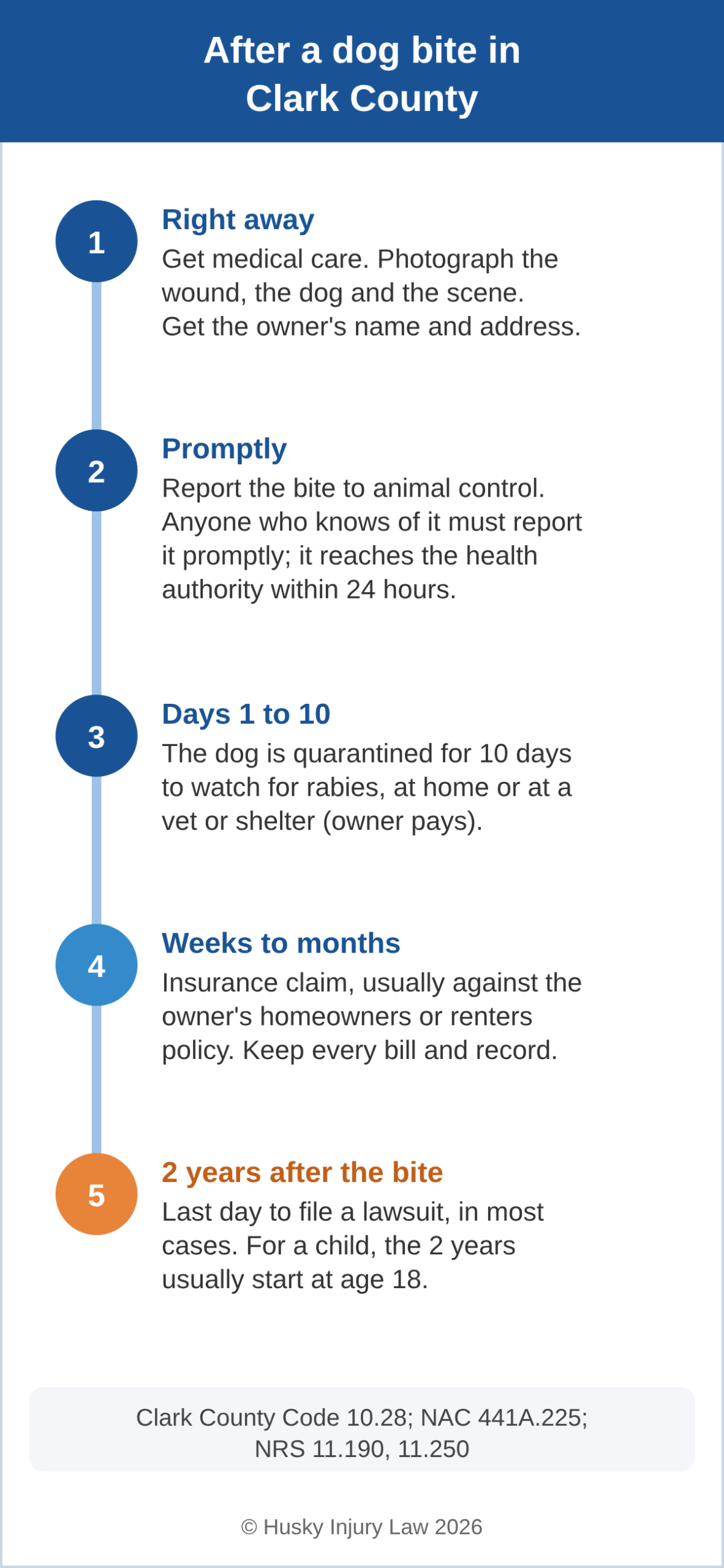
In Clark County, anyone who knows a person was bitten must promptly report it to animal control or the health officer.20 That includes the bitten person and the dog’s owner. Nevada health rules also require bite reports to reach the health authority within 24 hours.21
The 10-day quarantine
After a bite, the dog is quarantined for 10 days to watch for rabies. Animal control may allow home quarantine if the dog has no bite history and the yard is secure; otherwise the dog is confined at a vet or the animal shelter at the owner’s expense.22
For more on local rules, see 5 Clark County dog bite laws you may not have known.
10. Dogs on the Las Vegas Strip
Clark County bans most animals from the sidewalks and pedestrian bridges along the Las Vegas Strip, from Sahara Avenue to Sunset Road and 200 yards on either side. Household pets are allowed only from 5 a.m. to noon, on a leash no longer than 3 feet. Service animals and police dogs are exempt.23 Learn more about service animals at ADA.gov.
A dog on the Strip outside those hours, or on a longer leash, may support a negligence per se claim if it bites someone.
11. How long do I have to file?
In Nevada, you generally have 2 years from the date of the bite to file a personal injury lawsuit.24 If you miss it, the owner can ask the court to dismiss your case.
Bites to children
For a child’s own injury claim, the 2-year clock generally does not run until the child turns 18.25 Parents should still act early, while witnesses and evidence are fresh.
12. What to do after a dog bite in Las Vegas
Taking these steps after a dog bite in Nevada protects your health and your claim:
- Get medical care. Even small punctures can become infected.
- Identify the dog and owner. Get names, an address and the dog’s vaccination status.
- Report the bite to animal control in Clark County or your city.
- Photograph your injuries, the dog, the scene and any open gate or broken leash.
- Get witness names and phone numbers.
- Keep records of medical bills, missed work and your recovery.
- Don’t give the owner’s insurer a recorded statement before talking to a lawyer.

13. Frequently asked questions
Is Nevada a one-bite state?
Yes, in part. Nevada has no strict-liability dog bite statute, so an owner who knew or should have known the dog was dangerous is liable under the one-bite rule. An owner can also be liable for negligence or for breaking a leash law, even if the dog never bit anyone before.
Can someone sue you if your dog bites them on your property?
Yes. In Nevada, a person bitten on your property can sue if you knew the dog was dangerous or failed to use reasonable care. A “Beware of Dog” sign does not end your liability, though trespassers and people who provoke a dog may recover less or nothing.
How much is a dog bite claim worth in Nevada?
There is no set formula. The value depends on your medical bills, lost income, scarring and pain, and on how clearly the owner was at fault. Punitive damages, when allowed, are generally capped at 3 times compensatory damages or $300,000.
Do I have to report a minor dog bite in Las Vegas?
Yes. Clark County requires anyone who knows a person was bitten by an animal to report it promptly to animal control or the health officer, even if the bite seems minor. The dog then goes through a 10-day rabies quarantine.
Can I go to jail if my dog bites someone in Nevada?
Usually not for a first bite. Knowingly keeping a dog declared vicious for more than 7 days after notice is a misdemeanor in Nevada, and an attack by a known vicious dog that causes serious injury is a category D felony. Clark County can also fine an owner at least $500 when a careless owner’s dog attacks someone.
How many bites before a dog is put down in Nevada?
There is no set number. Under NRS 202.500, a judge may order a dog humanely destroyed when a dog known to be vicious seriously injures someone; otherwise, the dog is usually quarantined for 10 days and returned.
Does Nevada have a cat bite law?
No. Nevada has no separate cat bite statute. A cat bite claim uses the same negligence rules, and Clark County’s reporting and 10-day quarantine rules apply to any animal that can carry rabies.
How long do I have to sue after a dog bite in Nevada?
Generally 2 years from the date of the bite. For a child’s own claim, the 2 years usually do not start until the child turns 18.
Bitten by a dog in Las Vegas? Call us for help
If you or your child was bitten by a dog anywhere in Nevada, our Las Vegas dog bite lawyers can help you get compensation from the owner and their insurer. Call us or fill out the form below for a free consultation. We do not get paid unless and until you do.
Legal references:
- Nevada Jury Instructions: Civil (2018 ed.), Instruction 4.2 (Elements of Negligence Claim) and 4.3 (Duty and Ordinary Care: Definitions).
- Clark County Code 10.36.050 (Ord. No. 5214, Feb. 4, 2025): “An owner or keeper of an animal commits a violation of the code if that animal attacks and injures a person who did not provoke the animal prior to the attack if the owner or keeper failed to exercise reasonable care.” Subsection (c) sets a minimum fine of $500.
- Barnes v. Delta Lines, Inc., 99 Nev. 688, 690, 669 P.2d 709 (1983): “When a defendant violates a statute which was designed to protect a class of persons to which the plaintiff belongs, and thereby proximately causes injury to the plaintiff, such a violation constitutes negligence per se, unless the defendant can show that the violation was excused.”
- Nevada Jury Instructions: Civil (2018 ed.), Instructions 4.13 and 4.14 (Violation of Law as Negligence Per Se: No Evidence of Excuse or Justification; Jury Issue as To Excuse or Justification).
- Clark County Code 10.36.040(a): “No person owning or having possession of any animal other than a cat, shall cause, permit or allow the animal to stray, run or in any manner be at large.”
- Las Vegas Municipal Code 7.36.050: owners must keep animals “restrained by a fence, cage, coop, chain, leash or other adequate means so that the animal does not leave or escape from the premises upon which it is kept.”
- Henderson Municipal Code 7.08.020 (Ord. No. 4115, Oct. 21, 2025): animals “shall be on a leash and under effective control of the person holding said leash of the animal, when on any public property.”
- Clark County Code 10.36.050(b)(1): it is a defense to the county violation if “The attack occurred in an enclosure in which the animal was confined without means of escape, there was posted at the main entrance of the enclosure a notice to beware of the animal, and the person attacked entered or reached into the enclosure without invitation.”
- NRS 202.500. Full text (as of November 2026): “1. For the purposes of this section, a dog is: (a) ‘Dangerous’ if: (1) It is so declared pursuant to subsection 2; or (2) Without provocation, on two separate occasions within 18 months, it behaved menacingly, to a degree that would lead a reasonable person to defend himself or herself against substantial bodily harm, when the dog was: (I) Off the premises of its owner or keeper; or (II) Not confined in a cage, pen or vehicle. (b) ‘Provoked’ when it is tormented or subjected to pain. (c) ‘Vicious’ if: (1) Without being provoked, it killed or inflicted substantial bodily harm upon a human being; or (2) After its owner or keeper had been notified by a law enforcement agency that the dog is dangerous, the dog continued the behavior described in paragraph (a). 2. A dog may be declared dangerous by a law enforcement agency if it is used in the commission of a crime by its owner or keeper. 3. A dog may not be found dangerous or vicious: (a) Based solely on the breed of the dog; or (b) Because of a defensive act against a person who was committing or attempting to commit a crime or who provoked the dog. 4. A person who knowingly: (a) Owns or keeps a vicious dog, for more than 7 days after the person has actual notice that the dog is vicious; or (b) Transfers ownership of a vicious dog after the person has actual notice that the dog is vicious, is guilty of a misdemeanor. 5. If substantial bodily harm results from an attack by a dog known to be vicious, its owner or keeper is guilty of a category D felony and shall be punished as provided in NRS 193.130. In lieu of, or in addition to, a penalty provided in this subsection, the judge may order the vicious dog to be humanely destroyed. 6. A local authority shall not adopt or enforce an ordinance or regulation that deems a dog dangerous or vicious based solely on the breed of the dog. 7. This section does not apply to a dog used by a law enforcement agency …”
- Clark County Code 10.16.030: a declared-dangerous animal may be kept only with an annual permit and inspection (a), muzzled, leashed and under an adult’s control off the property (c), warning signs (d), sterilization (e), a microchip (f), insurance “in the amount of not less than one hundred thousand dollars” (g) and written approval before any sale or transfer (h).
- NRS 193.130(2)(d) (category D felony: 1 to 4 years in prison and up to $5,000) and NRS 193.150(1) (misdemeanor: up to 6 months in county jail, up to $1,000, or both).
- Harry v. Smith, 111 Nev. 528, 533–34, 893 P.2d 372, 375 (1995): “liability only lies if, under all of the circumstances of the case, the landowner takes affirmative steps to assume a duty.”
- Wright v. Schum, 105 Nev. 611, 618, 781 P.2d 1142, 1146 (1989): once the landlord learned of the danger and used “his power of eviction to force compliance,” he was no longer “non-negligent as a matter of law.”
- PetSmart, Inc. v. Eighth Jud. Dist. Ct., 137 Nev. 726, 731, 499 P.3d 1182, 1187 (2021): “Nothing in the record suggests that PetSmart knew about Chip’s aggressive tendencies, much less undertook affirmative steps to prevent the type of harm that ensued.”
- Nevada Jury Instructions: Civil (2018 ed.), Instruction 8.1 (Premises Liability: Essential Factual Elements).
- NRS 41.141(1): comparative negligence “does not bar a recovery if that negligence was not greater than the negligence or gross negligence of the parties to the action against whom recovery is sought”; the damages are reduced by the injured person’s share. See also Nev. J.I. Civ. 4.8 (Comparative Negligence: Definition: Effect).
- Nevada Jury Instructions: Civil (2018 ed.), Instructions 5.1 and 5.2 (Measure of Damages; Pain and Suffering: No Definite Standard).
- NRS 42.005(1): punitive damages require “clear and convincing evidence” of “oppression, fraud or malice, express or implied,” and may not exceed 3 times compensatory damages if those are $100,000 or more, or $300,000 if they are less. See also Nev. J.I. Civ. 12.1 (Punitive Damages: Recovery and Measure).
- NRS 687B.383(1): an insurer shall not refuse to issue, cancel, refuse to renew or raise the premium of a policy “based on the specific breed or mixture of breeds of a dog that is harbored or owned on an applicable property”; subsection 2 allows action for a dog known or declared to be dangerous or vicious under NRS 202.500.
- Clark County Code 10.28.020: “It shall be the duty of anyone with knowledge of a human being having been bitten by any animal, to promptly report the same to the health officer or to the animal control officer and to provide all pertinent information requested by them.”
- NAC 441A.225(7): a report of a bite by an animal susceptible to rabies goes to the health authority or rabies control authority within 24 hours.
- Clark County Code 10.28.030 and 10.28.040: home quarantine “for a period of ten days” when the animal control officer allows it; otherwise the animal is confined “at the owner’s expense” at a veterinarian or the animal shelter “for a period of ten days of observation.”
- Clark County Code 10.39.010: household pets “may be present in the restricted area between 5:00 a.m. and 12:00 noon each day. Such pets must be on a leash or other restraint not exceeding three feet in length.” The restricted area runs along Las Vegas Boulevard South from Sahara Avenue to Sunset Road, 200 yards on either side; service animals and police working animals are exempt.
- NRS 11.190(4)(e): within 2 years, “an action to recover damages for injuries to a person … caused by the wrongful act or neglect of another.”
- NRS 11.250: if the person entitled to sue was “Within the age of 18 years” when the claim arose, “the time of such disability shall not be a part of the time limited for the commencement of the action.”