Nevada law allows you to recover non-economic damages such as pain and suffering in a personal injury lawsuit. Non-economic damages are difficult to quantify with a monetary value.1
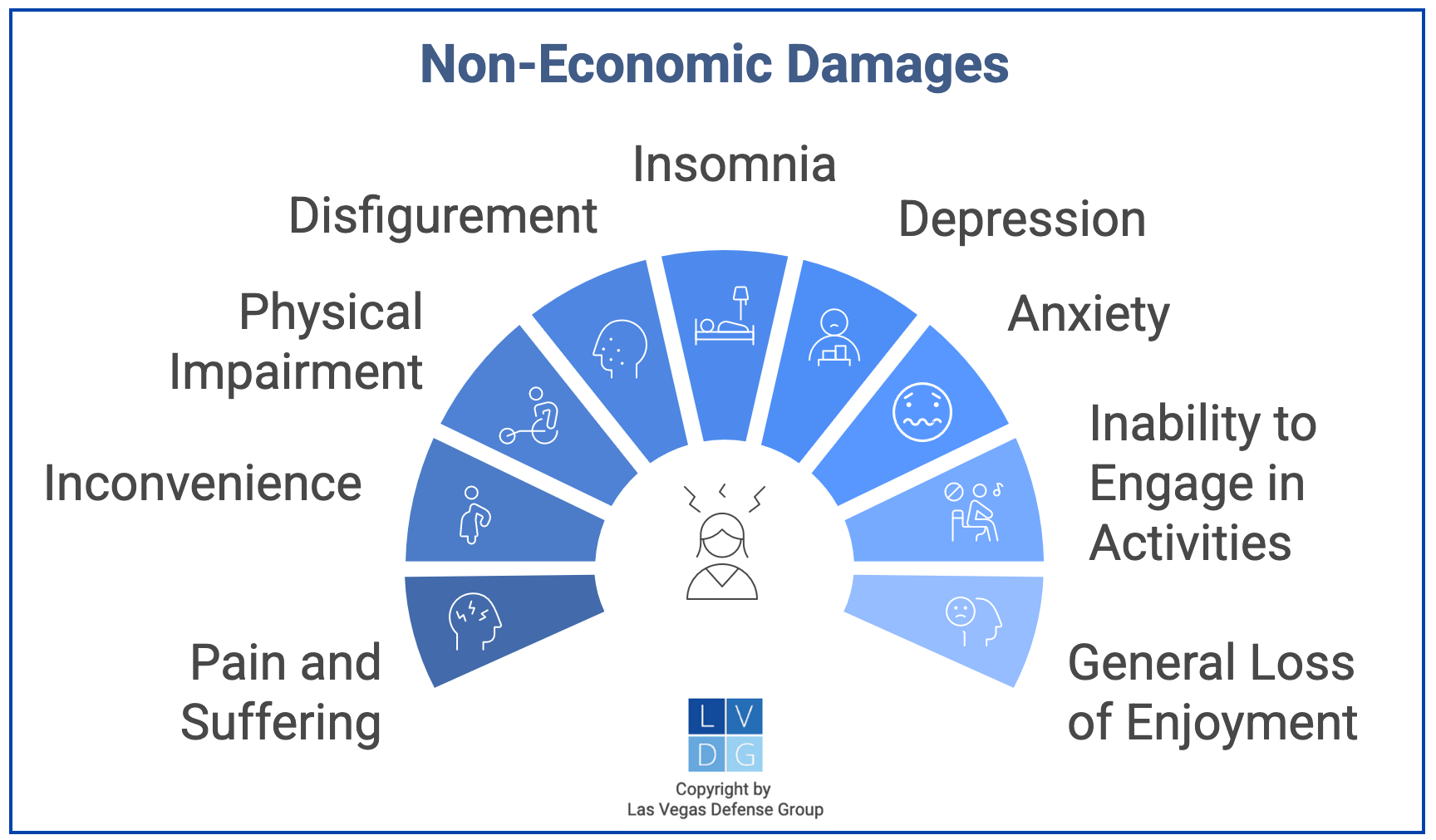
A physical injury is not required in order to recover damages for pain and suffering in Nevada. However, it makes the recovery more likely. For instance, plaintiffs are typically awarded non-economic damages following injuries from a:
- car accident,
- disfiguring dog bite,
- dangerous product accident, or even
- slip-and-fall or other injury at a Las Vegas hotel.
In this article, our Las Vegas personal injury lawyers address the following key issues regarding pain and suffering in Nevada law.
1. Caps
Except in medical malpractice cases, there is no upper limit to the amount you can recover for non-economic damages in a Nevada lawsuit. The only requirement in Nevada is that damages for pain, suffering, disfigurement, etc. ,must be fair and reasonable.
If you simply had a few sleepless nights while you waited to find out whether your toe was fractured, your damages for pain and suffering are likely to be minimal. On the other hand, if you required reconstructive surgery and months of physical therapy, your recovery will be much higher.
While a physical injury is not required, non-economic damages tend to increase when:
- There is a permanent disfigurement or loss of function,
- Medical bills are high,
- Physical injuries are verifiable by medical tests such as x-rays, or
- Recovery was difficult and/or took a long time.
Example: Mary suffers a catastrophic injury when her wrist is shattered when her car is involved in an accident with a truck on the Las Vegas Beltway. Repairing her wrist requires several surgeries and almost a year of painful physical therapy. Even so, Mary never fully recovers her grip strength or range of motion, and she is left with permanent scars.
Because the injury is externally verifiable and the damage is permanent, then as long as Mary can prove that the truck driver was responsible (or mostly responsible) for the accident, she has a good case for recovering damages for her pain, suffering and other non-economic losses.
Medical Malpractice Caps
In a Nevada medical malpractice (“professional negligence”) case in 2026, non-economic damages such as pain and suffering are capped at $590,000. It does not matter how many plaintiffs, defendants, or theories of liability the case has.2
The cap was approved by Nevada voters as part of 2004’s “Keep Our Doctors in Nevada” ballot initiative (Question No. 3). The Nevada Supreme Court has held that this cap is constitutional. The cap increases by $80,000 every year until it hits $750,000 in 2028.3
2. Evidence
Non-economic damages are subjective. “Proving” them is a matter of convincing the jury (or the defendant’s insurer or lawyer) to award them. Typical ways of proving pain and suffering include the following:
Medical Records
X-rays and similar visual test results are powerful in making the subjective experience of an injury real for the jury. The more complete the medical record, the more likely you are to receive damages for pain and suffering – even if your injuries are relatively minor or not obvious.
It is extremely important, therefore, to have your doctor and therapist(s) take comprehensive treatment notes. Your Las Vegas personal injury attorney can help educate your healthcare professionals on what type of documentation is needed to establish your claim.
also be sure to sign in for every appointment you have and not miss appointments.
Photographs and Videos
Before and after photos or videos can be an excellent way to illustrate non-economic losses. If you are doing rehabilitative therapy, it may be helpful to videotape some of your sessions so that the jury can see what you have had to go through.
You will need to make sure your therapist consents to be videotaped. Ideally, they should also be available to testify. Your attorney can make inquiries on your behalf if doing so makes you uncomfortable.
Past Social Media Posts, Texts and Emails
Your social media presence can often make or break your case for non-economic damages. You should not rely on privacy settings to protect yourself.
Posting a video of yourself skiing on vacation can undermine your claim that you are suffering. On the other hand, while not dispositive, evidence that you joined a group for dealing with a certain type of pain or recovery may bolster your doctor’s testimony.
Testimony of Friends, Family, Therapists and Co-Workers
While you are perfectly capable of testifying to your own suffering, it is more powerful to have other people do it. Most effective of all can be vignettes illustrating how your life has changed since an accident or injury.
For instance, perhaps you have stopped going to social events or participating in your usual activities. Sometimes just knowing you have a group of people willing to testify on your behalf can inspire an insurance adjuster to increase a settlement offer.
An experienced Las Vegas injury lawyer can often help you obtain signed declarations in the proper form.
Treatment by a Mental Health Professional
Counseling is not required for pain and suffering to be awarded, but is usually necessary when there is an absence of physical injury. If you are claiming injuries such as insomnia, anxiety or depression, a therapist can explain to the jury why such claims are real and exceptional.

3. Calculating Pain and Suffering
The good news is that Nevada pain and suffering settlement amounts are negotiable. However, many insurers do use a computer to tell them what is an acceptable settlement amount in a Nevada personal injury lawsuit.
You can approximate these calculations using either of two common historical methods for calculating pain and suffering damages.
1) Multiply Your Compensatory Damages
The first method is to multiply the compensatory (actual) damages by a number between one and five, depending on how serious the injury was.
Example: Jim’s leg gets broken in an Uber accident in Las Vegas when his driver runs a red light. The injury requires several months of physical therapy, but Jim’s leg fully heals. Jim’s medical bills, rehab and lost wages total approximately $20,000.
After extended negotiation, Jim’s attorney and the insurance adjuster settle on a multiplier of three. If Jim approves of this out-of-court settlement, the insurance company will write him a check for three times $20,000, for a total settlement of $60,000.
The more serious and long-term the injury and the more painful the treatment, the higher the number you would use. Physical injuries that can be proven with x-rays, photos and test results usually merit a higher multiplier than purely subjective injuries (such as depression or insomnia).
Very large awards of pain and suffering damages are sometimes paid out over a longer period time by way of a structured settlement.
2) “Per Diem” Method
The second method is the so-called “per diem” (per day) method. Under this approach, you would ask for a certain amount of money for each day you experienced pain and suffering.
For instance, if Jim in the above example took 60 days to heal his broken leg, he might ask for $150 per day ($9,000 total) in addition to his compensatory damages. This means Jim would receive $20,000 plus $9,000 for a total settlement of $29,000.
Ultimately, however, what you receive as a personal injury settlement in Nevada, is likely to be the result of a negotiation in which your attorney must establish several factors. These include:
- Your out-of-pocket costs,
- The severity of your injuries,
- The seriousness of the defendant’s wrongdoing,
- The strength of your case, and
- The likelihood of your taking the case to trial.4

Frequently Asked Questions
What is the difference between “special” damages and “general” damages?
In tort law, damages are generally split into two categories.
- “Special damages” (also known as economic damages) refer to actual, easily calculated out-of-pocket expenses, such as vehicle repair estimates or medical bills.
- “General damages,” on the other hand, include pain and suffering. Unlike special damages, general damages have no set monetary cost and are awarded based on what a jury or insurance company deems “reasonable” based on your circumstances.
How do my specific hobbies or daily routines impact my pain and suffering calculation?
The way an injury disrupts your specific daily life heavily impacts your calculation.
For example, if you worked out at the gym every day prior to your accident and can no longer do so, your pain and suffering calculation will likely be higher than someone who did not have an active routine. Loss of enjoyment of life is highly personal to your pre-injury lifestyle.
Does my role as a parent affect my pain and suffering settlement?
It can. If your injuries impact your ability to fulfill your daily parenting duties, this is factored into your loss of enjoyment of life.
For example, a stay-at-home parent who can no longer lift their children, or who has to hire a nanny to take over childcare duties due to an injury, would likely receive a greater pain and suffering award to reflect that hardship.
Can I claim damages for severe trauma like PTSD?
Yes. While general anxiety and embarrassment are commonly factored into non-economic damages, the development of severe psychological disorders such as Post-Traumatic Stress Disorder (PTSD) following an accident is a major factor that will significantly increase a pain and suffering calculation.
Additional Reading
For more in-depth information, refer to these scholarly articles:
- Pain and Suffering Damages in Personal Injury Cases: An Empirical Study – Journal of Empirical Studies.
- Pain and Suffering, Non-economic Damages, and the Goals of Tort Law – S.M.U. Law Review.
- Putting a Price on Pain-and-Suffering Damages: A Critique of the Current Approaches and a Preliminary Proposal for Change – Northwestern University Law Review.
- Pain and Suffering Awards: They Shouldn’t Be (Just) about Pain and Suffering – The Journal of Legal Studies.
- Making the intangible tangible: Collecting damages for pain and suffering – New Jersey Law Journal.