
Quick summary
After a bus accident in Las Vegas, you can sue the bus company for its driver’s negligence, and often the bus maker, another driver or a government agency too. Nevada law holds bus companies to a heightened duty to keep their passengers safe.
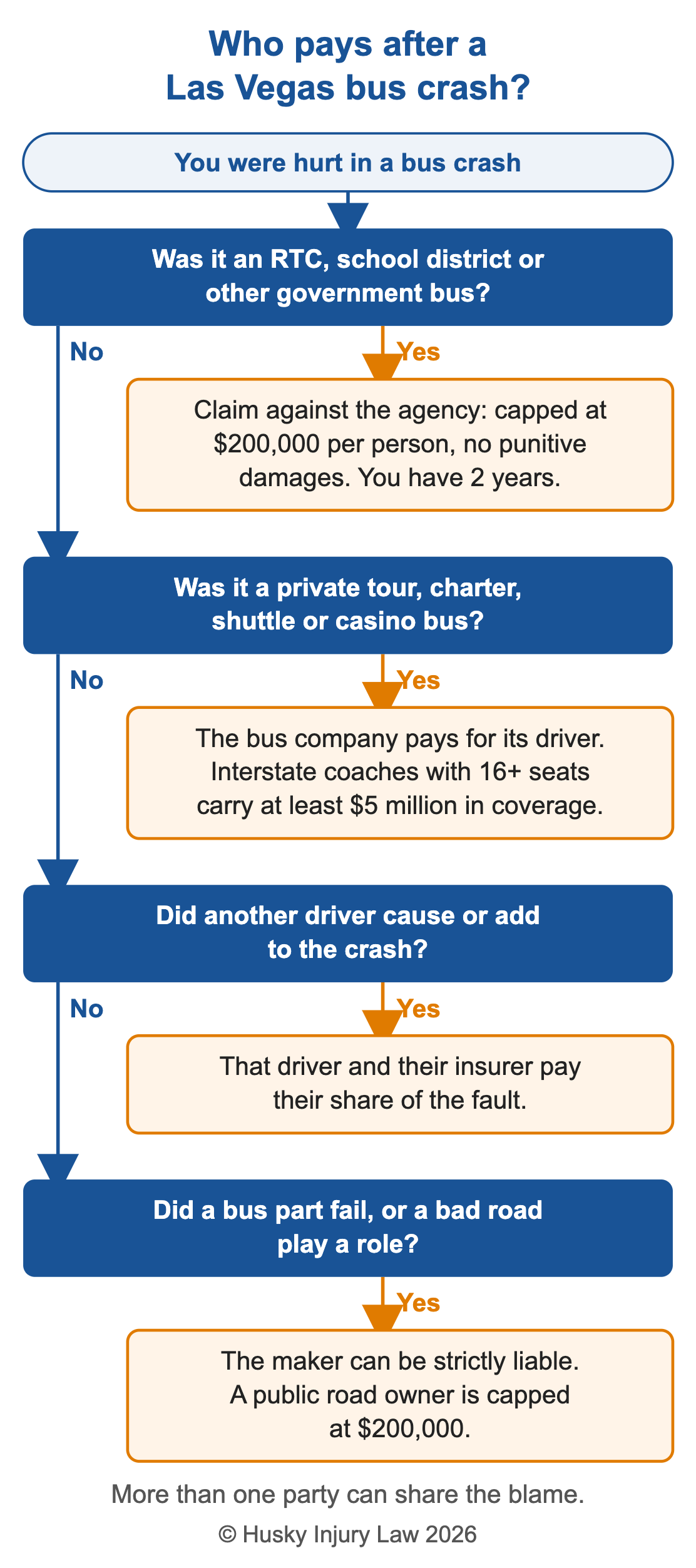
- Who you can sue: The driver, the bus company, another motorist, the maker of a defective bus, or the RTC or school district.
- Government buses: Claims against the RTC or a school district are capped at $200,000 per person, with no punitive damages.
- Deadline: You generally have 2 years from the crash to sue, including claims against government agencies.
- Example: Maria is standing on an RTC bus when the driver brakes hard to make a light, and she falls and breaks her wrist. She may have a claim against the RTC for failing to drive safely.
In this article, our Las Vegas personal injury lawyers answer 9 common questions about bus accident lawsuits in Nevada:
- 1. Can I sue after a bus accident in Las Vegas?
- 2. Who can be liable for a bus accident?
- 3. Are bus companies held to a higher standard?
- 4. What if it was an RTC or school bus?
- 5. How long do I have, and what should I do first?
- 6. What can I recover?
- 7. What if I was partly at fault?
- 8. Hurt on a tour bus from out of state?
- 9. FAQ
1. Can I sue after a bus accident in Las Vegas?
Yes. In Nevada, you can sue whoever’s carelessness caused the bus crash, whether you were a passenger, another driver, a cyclist or a pedestrian. To win, you must show that the defendant owed you a duty of care, breached it, and caused your injuries and losses.1
Types of buses in Las Vegas
Who you sue, and which rules apply, depends on what kind of bus it was:
- RTC transit buses, including the Deuce on the Strip, run by the Regional Transportation Commission of Southern Nevada (a government agency)
- School buses run by the Clark County School District
- Tour and charter coaches, such as Grand Canyon and Hoover Dam tours and interstate lines
- Casino, hotel and airport shuttles
- Party buses and limo buses
We also handle bus stop injuries and shuttle bus accidents.
Common causes of bus crashes
Bus crashes usually come down to driver error or poor upkeep, such as:
- Driver fatigue or driving past federal hours limits
- Distraction, speeding or running lights
- Sudden or hard braking that throws standing passengers
- Unsafe turns into bike lanes and crosswalks
- Poor maintenance of brakes, tires and doors
- Impairment from alcohol or drugs
2. Who can be liable for a bus accident?
In Nevada, a bus company is liable for its driver’s negligence on the job.2 You can name both the driver and the company. The company usually has the larger insurance policy.
Depending on the crash, other parties may share the blame:
- Another motorist who cut off or hit the bus
- The bus or parts maker, if a defect such as failed brakes caused the crash (see product liability)
- A maintenance contractor that repaired the bus badly
- The city, county or state, if a dangerous road or broken signal played a role
Nevada holds makers and sellers of defective products strictly liable: you need to show a defect that caused your injury, not carelessness.3 A product can be defective in design, in how it was made, or in its warnings.4

Example: James is driving through an intersection in Henderson when a charter bus turns left in front of him. The bus company is liable for its driver’s mistake, and James can bring his claim against the company’s insurer.
3. Are bus companies held to a higher standard?
Yes, toward their passengers. Nevada treats bus operators as “common carriers,” which owe passengers a heightened duty of care for risks that come from the transportation itself, such as how the bus is driven, braked and boarded. For other risks, the carrier owes ordinary reasonable care, which includes reasonable help for a passenger it knows has a disability.5
Toward other drivers, cyclists and pedestrians, a bus driver owes the same reasonable care as any driver.6
Federal safety rules for tour and charter buses
Tour and charter buses that cross state lines must follow federal safety rules. A driver of a passenger bus may not drive more than 10 hours after 8 hours off duty, or at all after being on duty 15 hours.7 For-hire buses seating 16 or more must carry at least $5 million in liability insurance ($1.5 million for 15 or fewer).8
Breaking a safety law can be “negligence per se” in Nevada, which means the violation itself counts as negligence if you were among the people the law protects.9 See our page on negligence per se.
4. What if it was an RTC or school bus?
You can sue the RTC, the Clark County School District or another public agency in Nevada, but special rules apply. Damages are capped at $200,000 per person, and no punitive damages are allowed.10
You have 2 years to file a claim with the agency, and filing that claim is not required before you sue.11 Some websites say claims against Nevada agencies need written notice within months; under Nevada law, that isn’t so.
School buses
In Nevada, drivers must stop for a school bus that is stopped with its red lights flashing and may not pass until the lights go off.12 A driver who hits a child after passing a stopped school bus may be negligent per se. If the school bus driver was at fault, the claim is against the school district, under the same $200,000 cap.
5. How long do I have, and what should I do first?
In Nevada, you generally have 2 years from the date of the crash to file a personal injury lawsuit.13 If you miss this statute of limitations, you will likely lose your claim.
After a bus accident in Las Vegas:
- Get medical care right away, and keep every record and bill.
- Report the crash to police and get the report number. On an RTC bus, also ask for the incident number.
- Take photos of the bus, the bus number, the scene and your injuries.
- Get names of the driver, passengers and witnesses.
- Ask in writing that the company keep its video. Most buses have onboard cameras, electronic driver logs and engine data, which can be recorded over.
- Don’t give a recorded statement to the bus company’s insurer before talking to a lawyer.
In our experience, bus companies and their insurers send investigators to the scene within hours. We move quickly to request the video, driver logs and maintenance records before they are lost.

6. What can I recover?
In a Nevada bus accident case, you can seek damages for:
- Medical bills, including therapy and rehabilitation, past and future
- Lost wages and lost earning capacity
- Pain and suffering
- Wrongful death damages, if a loved one was killed14
Punitive damages are possible only with clear and convincing proof of oppression, fraud or malice, and they are usually capped at 3 times your other damages. A bus company pays them for its driver’s conduct only in limited cases, such as when it knew the driver was unfit and hired them anyway.15 They are not available against a government agency.
In our experience, most bus accident cases settle without a trial once the evidence is in.
7. What if I was partly at fault?
Nevada uses comparative negligence. You can still recover as long as your share of the fault is not greater than the combined share of the defendants, and your award is reduced by your percentage of fault.16
Example: Kevin is hit by a bus while crossing outside a crosswalk on Boulder Highway. The jury finds the bus driver 70% at fault for speeding and Kevin 30% at fault. If his damages are $100,000, he recovers $70,000.
8. Hurt on a tour bus from out of state?
Las Vegas visitors are often hurt on interstate tour or coach buses. A Nevada court can’t always hear the case just because the trip ended in Las Vegas. In 2025, the Nevada Supreme Court upheld the dismissal of a negligence case against Greyhound over a shooting on its bus in California, though the passenger was headed to Las Vegas.17
Where the crash happened, and where the bus company is based, decide where you can sue. A crash in Nevada can be brought in Nevada. Talk to a lawyer early so the case is filed in the right state before the deadline runs.

Example: Ana, visiting from Arizona, is injured when her charter coach rear-ends a truck on I-15 just outside Las Vegas. Because the crash happened in Nevada, she can sue the bus company in a Nevada court.
9. FAQ
Can I sue the RTC after a bus accident in Las Vegas?
Yes. The RTC is a government agency, so Nevada caps your damages at $200,000 and bars punitive damages. You have 2 years to file.
How long do I have to sue a bus company in Nevada?
Generally 2 years from the date of the crash under NRS 11.190. Act sooner so the bus video and driver logs are still available.
Is a bus company liable for its driver in Nevada?
Yes. A Nevada bus company is liable for its driver’s negligence on the job, and it owes passengers a heightened duty of care for risks from the ride itself.
What is a bus accident claim worth in Nevada?
It depends on your medical bills, lost income, pain and suffering and who is at fault. Claims against private bus companies are not capped; claims against the RTC or a school district are capped at $200,000 per person.
I’m a tourist. Can I sue in Nevada after a bus crash in Las Vegas?
Yes, if the crash happened in Nevada. If you were hurt on a bus in another state, a Nevada court may not be able to hear the case.
What if a school bus hit my car in Las Vegas?
You can bring a claim against the Clark County School District. Your damages are capped at $200,000, and you have 2 years to file.
Hurt in a bus accident? Our Las Vegas personal injury lawyers offer a free consultation, and we take cases on contingency, so there is no fee unless we win. We help bus accident victims in Las Vegas, Henderson, North Las Vegas, Reno and throughout Nevada. Contact Husky Injury Law today.
See also: Does Nevada have a bus accident statute?, pedestrian accidents in Las Vegas, commercial vehicle accidents and negligence.
Legal references:
- Nevada Jury Instructions: Civil 4.2 (Elements of Negligence Claim) (State Bar of Nevada, 2018 ed.).
- NRS 41.130. See also Nevada Jury Instructions: Civil 15.3 (State Bar of Nevada, 2018 ed.).
- Shoshone Coca-Cola Bottling Co. v. Dolinski, 82 Nev. 439, 420 P.2d 855 (1966). See also Nevada Jury Instructions: Civil 7.1 (State Bar of Nevada, 2018 ed.). (Shepard’s checked Nov. 17, 2026: no negative history.)
- Nevada Jury Instructions: Civil 7.2 (design defect), 7.3 (manufacturing defect) and 7.4 (warning defect) (State Bar of Nevada, 2018 ed.).
- First Transit, Inc. v. Chernikoff, 135 Nev. Adv. Op. 32, 445 P.3d 1253 (2019): the heightened duty “only applies to transportation-related risks,” and for other risks “the common carrier owes a duty of reasonable care.” (Shepard’s checked Nov. 17, 2026: no negative history.)
- Nevada Jury Instructions: Civil 4.3 (Duty and Ordinary Care) (State Bar of Nevada, 2018 ed.).
- 49 CFR 395.5(a): no driver may drive a passenger-carrying commercial motor vehicle “[m]ore than 10 hours following 8 consecutive hours off duty” or “[f]or any period after having been on duty 15 hours.”
- 49 CFR 387.33 (for-hire motor carriers of passengers in interstate commerce: $5,000,000 for vehicles seating 16 or more passengers including the driver; $1,500,000 for 15 or fewer).
- Nevada Jury Instructions: Civil 4.13 and 4.14 (Violation of Law as Negligence Per Se) (State Bar of Nevada, 2018 ed.).
- NRS 41.031; NRS 41.035(1): an award against the state or a political subdivision “may not exceed the sum of $200,000 … to or for the benefit of any claimant” and “may not include any amount as exemplary or punitive damages.”
- NRS 41.036(2)–(3): a claim against a political subdivision must be filed with its governing body “within 2 years after the time the cause of action accrues,” and filing it “is not a condition precedent to bringing an action.”
- NRS 484B.353(1) (drivers must stop for a stopped school bus displaying flashing red lights and may not pass until the lights stop).
- NRS 11.190(4)(e).
- NRS 41.085.
- NRS 42.005; NRS 42.007. See also Nevada Jury Instructions: Civil 12.1–12.2 (State Bar of Nevada, 2018 ed.).
- NRS 41.141. See also Nevada Jury Instructions: Civil 4.8 (State Bar of Nevada, 2018 ed.).
- M.I.A.W. v. Greyhound Lines, Inc., 141 Nev. Adv. Op. 33, 570 P.3d 150, 153 (2025) (affirming dismissal for lack of personal jurisdiction). (Shepard’s checked Nov. 17, 2026: no negative history.)