Nevada’s statute of limitations to bring a slip-and-fall lawsuit is generally two (2) years from the date of the injury. For example, if you tripped and broke your leg in a Las Vegas casino on January 1, 2026, then you must file your lawsuit against the casino no later than January 1, 2028.
People often assume they have plenty of time to decide whether to pursue a claim. Unfortunately, waiting too long is one of the biggest mistakes I see. If you wait too long to file your lawsuit, your claim will be dismissed for staleness. It makes no difference if you would have otherwise won the lawsuit had you brought it sooner.
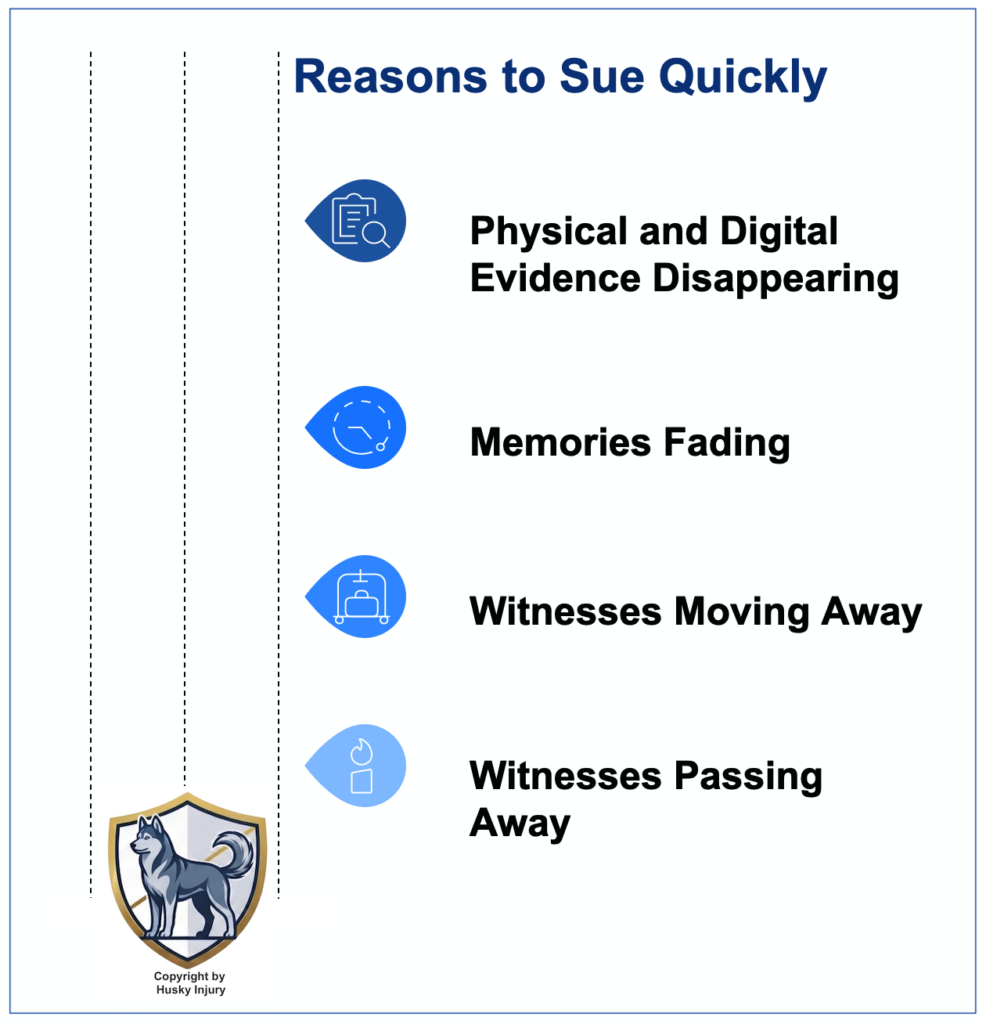
One thing I tell clients is that the legal deadline is not the date you should have in mind—it’s the latest possible date. The strongest cases usually begin much earlier, when we still have access to photographs, security footage, witnesses, and the conditions that caused the fall. Starting early often gives us far more leverage during settlement negotiations.
Exceptions to the Two-Year Rule
There are limited situations where you have longer or shorter than two years to bring a slip-and-fall lawsuit:
- Minor children: If your minor child was the victim, the statute of limitations pauses (“tolls”) until they turn 18.
- Comas: If the fall causes you to fall into a coma, the statute of limitations tolls until you regain consciousness.
- Out-of-state defendant: If the at-fault party is not in Nevada, the statute of limitations tolls while they remain out of state.
Nevada also follows the “discovery rule,” which says the statute of limitations does not start running until you discover – or reasonably should have discovered – your injury. Sometimes injuries do not manifest until long after the actual accident.1
In cases I have handled, people are often surprised that the statute of limitations is not always straightforward. Questions about minors, delayed discovery of injuries, or government-owned property can change the analysis. That’s why I never recommend assuming an exception applies without first reviewing the specific facts.
If You Fall At Work
If you fall at work in Nevada and plan to seek workers’ compensation, you must notify the employer and submit an Incident Report within only seven days of your injury. Within 90 days of the injury, the Employee’s Claim for Compensation form must be submitted as well.
Workers’ comp is typically the exclusive remedy for employees injured at work. Though there are certain situations where it may be possible to bring a traditional personal injury lawsuit within the two-year statute of limitations.
Learn more about Nevada workers’ compensation laws.

Statute of Limitations for Injury to Property
Nevada law gives you three years to sue if your fall causes property damage, such as broken:
- eyeglasses,
- phones and tablets,
- watches,
- jewelry, or
- objects you were holding at the time.
If all you suffered was property damage, I would still encourage you to bring your case as soon as possible to maximize your odds of winning a large settlement.2
Winning Your Case
Most slip-and-fall lawsuits I handle involve you (the plaintiff) suing the property owner (defendant) for negligence on premises liability grounds. To prevail in these lawsuits, we would have to prove the following elements by a preponderance of the evidence:
- The defendant owns the premises or is in control of the place where the fall occurred;
- You were on the premises with the defendant’s consent;
- A falling hazard exists on the premises;
- Defendant caused, knew of, or should have known of the slip-and-fall hazard; and
- The falling hazard caused you to suffer an injury and/or other damages.3
Typical evidence in these cases includes any of the following:
- Video surveillance footage of the incident (especially if it took place in a store or casino)
- Eyewitness testimony
- Photographs of the aftermath of the incident and what you slipped on
- Medical records
- Samples of the substance you slipped on
- Your shoes
- Property maintenance records
In my experience, the biggest challenge in many slip-and-fall cases isn’t proving that someone was injured—it is proving the property owner had enough notice of the dangerous condition to fix it. That is why we spend so much time gathering maintenance records, surveillance footage, witness statements, and inspection logs before they disappear.

How Defendants Fight Your Claims
Depending on the circumstances of the case, defendants in slip-and-fall cases may try to argue the following in order to escape liability:
- The defendant adequately warned you of the falling hazard, such as by cordoning off the area;
- The falling hazard was open and obvious, and any reasonable person would have avoided it;
- Your injuries were caused by your preexisting conditions, not by the fall;
- You failed to exercise due care on the premises, such as by running too fast, or by texting while walking; and/or
- An intervening cause unrelated to the defendant caused the injury, such as a third party pushing you.
Do not be intimidated by their attacks. There are many ways we can show their claims are baseless or irrelevant.
How Much Money You Can Get
When negotiating an accident claim, I fight to recover enough compensatory damages to cover all your:
- Medical expenses, including hospital stays, clinical visits, telehealth appointments, braces, rehabilitation, medications, and home health care;
- Lost wages from being unable to work while recovering from the injury;
- Loss of future earnings if you can no longer work due to the injury;
- Pain and suffering, which is often the biggest expense.
Even if you were partially to blame for the fall, you should be eligible for reduced damages as long as you were no more than 50% at fault. Learn more about Nevada’s comparative negligence laws.3
Should the case reach trial, we can also ask the court to award punitive damages. If the compensatory damages are less than $100,000, punitive damages are capped at $300,000. Otherwise, punitive damages are capped at three times the compensatory damages. The sole purpose of punitive damages is to punish the defendant for the behavior that led to the accident.4
I always remind clients that a slip-and-fall case is about much more than paying today’s medical bills. Many injuries continue to affect someone’s ability to work, exercise, care for family members, or simply enjoy daily life. Those long-term consequences deserve to be documented just as carefully as the emergency room visit.
5 Steps to Take After a Fall
- Get medical help. See a doctor right away, even if you feel uninjured. Some injuries take time to manifest.
- Document everything. Use your phone to photograph the accident scene, your injuries, and anything else that might be relevant. Also keep copies of any receipts related to your fall, like medical bills.
- Gather eyewitnesses. If anyone saw the fall, get their contact information.
- DO NOT ADMIT FAULT. Even if you believe you were to blame, you could be wrong. Any admission of guilt could prevent you from recovering damages later.
- Contact an attorney. Insurance companies will try to discourage you by blame-shifting or offering a low-ball settlement, but I know their tricks and will not quit fighting until we achieve the best settlement possible under the law.
One habit I have seen make a tremendous difference is using your phone immediately after the accident—if you are physically able—to photograph the hazard from multiple angles before it’s cleaned up or repaired. Those photos often become some of the most persuasive evidence in the entire case because they capture the condition exactly as you encountered it.

Frequently Asked Questions
Do I have to report a slip-and-fall accident to the property owner?
Nevada law does not generally require you to complete an incident report before filing a slip-and-fall lawsuit. However, you should report the accident to the property owner, manager, security department, or another responsible employee as soon as reasonably possible. Ask for a copy of the completed report, but avoid speculating about fault or minimizing your injuries.
Reporting the accident creates a record showing when and where the fall occurred. It can also prompt the business to preserve surveillance footage, photographs, maintenance records, and information about employees or witnesses who were present.
I always tell clients to report the accident before leaving if they are physically able. A simple incident report can make it much harder for a property owner to later argue that the accident never happened or occurred somewhere else.
Does filing an incident report stop Nevada’s two-year statute of limitations?
No. Reporting the accident to the property owner, submitting an insurance claim, or negotiating with an insurance adjuster does not ordinarily constitute filing a lawsuit or stop the statute of limitations. A Nevada civil action is commenced by filing a complaint with the appropriate court.
This means settlement negotiations can continue while the filing deadline approaches. You should not assume that an insurer’s willingness to discuss the claim extends the deadline. Unless a valid exception or written tolling agreement applies, the complaint generally must be filed within two years of the injury.
In my experience, this is one of the most common misconceptions. People assume that because they are talking with the insurance company, their legal rights are protected. Unfortunately, negotiations can continue right up until the filing deadline, and if no lawsuit has been filed by then, the claim may be lost.
What do I have to prove in a Nevada slip-and-fall case?
You generally must prove that the defendant owned, occupied, or controlled the property; that a dangerous condition existed; that the defendant created the condition or knew or should have known about it; and that the condition caused your injuries and damages. It is not enough to prove only that you fell on someone else’s property.
Evidence may include surveillance video, photographs, witness statements, incident reports, inspection schedules, cleaning logs, repair records, medical records, and evidence showing how long the hazard existed. Because some of this evidence may be erased or lost quickly, it is important to investigate the accident promptly.6
In cases I have handled, the outcome often turns on small pieces of evidence that do not seem important at first—a wet floor that was not marked, a missing inspection, or surveillance footage showing how long a hazard existed. That is why we begin investigating as early as possible.
Why should I seek medical care promptly after a slip and fall?
Prompt medical care can identify injuries that are not immediately obvious, such as concussions, soft-tissue injuries, fractures, or back injuries. Medical records can also help establish that your condition resulted from the fall and document the treatment, expenses, limitations, and pain caused by the accident.
A delay in treatment does not automatically prevent you from recovering compensation. However, the property owner or insurance company may argue that the delay shows you were not seriously injured or that something else caused your condition.
I tell clients not to “tough it out” after a fall. Some injuries, especially head injuries, back injuries, and torn ligaments, can take hours or even days to become fully apparent. Getting evaluated promptly is usually better for both your health and your legal claim.
What if my slip and fall damaged my property as well as injured me?
Nevada generally provides two years to sue for personal injuries caused by another person’s wrongful act or neglect and three years to sue for damage to personal property. Property damage from a fall might include broken eyeglasses, a damaged phone, jewelry, clothing, or another item you were carrying.
When the same accident causes both bodily injuries and property damage, you should work from the shorter two-year personal-injury deadline. The additional year for property damage does not extend the deadline for seeking compensation for medical expenses, lost income, or pain and suffering.
In my experience, people often focus on replacing a broken phone or pair of glasses while overlooking the much larger costs associated with medical treatment and lost wages. We make sure every category of damage is documented so nothing gets left out of the claim.
Can I wait until I finish medical treatment before filing a slip-and-fall lawsuit?
You do not have to finish medical treatment before filing your lawsuit. In many cases, treatment continues beyond the point when a complaint must be filed. Your attorney may use medical opinions, treatment plans, and expert testimony to estimate future medical expenses and other continuing losses.
Waiting for your condition to stabilize can sometimes help with settlement valuation, but waiting must not cause you to miss the statute of limitations. Filing the complaint preserves the case while treatment, discovery, and settlement negotiations continue.
I always explain that filing a lawsuit and finishing treatment are two different things. Many successful cases are filed while clients are still recovering. Waiting for complete recovery can sometimes mean waiting too long to protect your legal rights.
Additional Reading
For more information, refer to our related articles by our Las Vegas slip and fall lawyers:
- Can I sue if I had a slip and fall in a Las Vegas hotel? What to do if you are injured in a hotel.
- Can I sue after falling on a slippery floor at a Vegas nightclub? Your options if you are injured in a nightclub.
- How to file a slip and fall claim in Las Vegas – 5 key steps. Guide to bringing a slip and fall lawsuit.
- I had a slip and fall in a Las Vegas hotel. Can I file a lawsuit? Your options if you are injured in a hotel.
Legal References
- NRS 11.190. NRS 11.300. NRS 11.310. Igtiben v. Eighth Jud. Dist. Ct. (Nev.App. 2024) 545 P.3d 116.
- NRS 11.190.
- See, for example, Turner v. Mandalay Sports Entm’t, LLC, (2008) 124 Nev. 213, 180 P.3d 1172; Cox v. Copperfield (Nev. 2022) .
- NRS 41.141.
- NRS 42.005.
- Moore v. Primadonna Co., LLC (Nev. App. 2026) 142 Nev., Adv. Op. 2 (Nevada generally requires proof that the property owner created the dangerous condition or had actual or constructive notice of it. However, in some self-service businesses, Nevada recognizes the “mode-of-operation” doctrine, which may affect how notice is established).