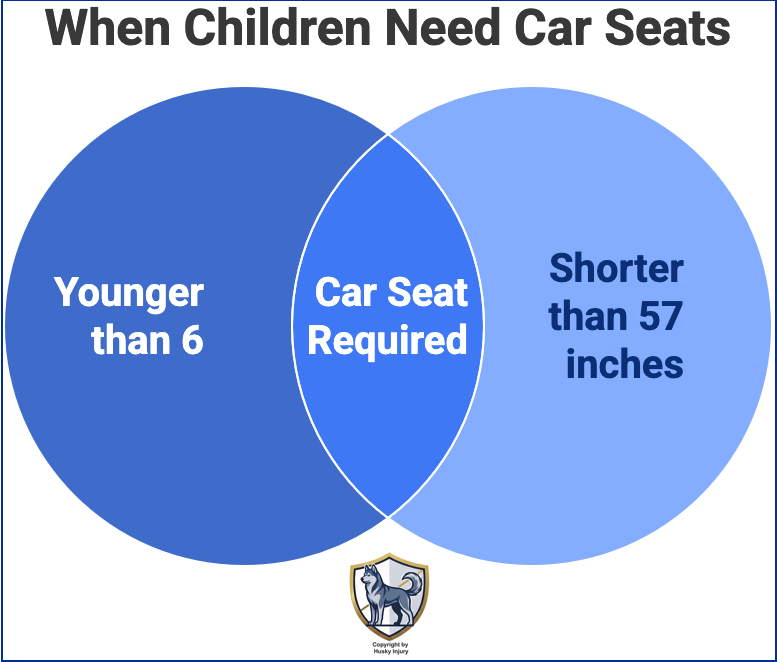
In Nevada, children under 6 years old and under 57 inches tall (4 feet, 9 inches) must ride in an approved child restraint system that fits them and is installed securely. NRS 484B.157 spells out the rules depending on the child’s age.
Car Seat Rules by Age
- Under age 2: Use a rear-facing car seat in the back seat, unless a statutory exception applies.
- Ages 2 through 5 and under 57 inches: Use an appropriate child restraint, such as a seat with a harness or a booster seat.
- Age 6 or at least 57 inches: Nevada’s child-restraint requirement no longer applies, but the child must wear an available seat belt. A booster seat remains the safer choice until the belt fits properly.
For safety, you are advised to keep children in the back seat until at least age 12. A properly fitted seat belt rests low across the upper thighs, with the shoulder belt crossing the chest rather than the neck or face.
Car Seat Violations
- Personal injury: A car seat violation cannot be used as evidence of negligence in a car crash; an injured child may still have a claim against a driver or other responsible party.
- Criminal: Drivers cited for failing to properly secure child passengers face fines or community service.
In this article, our Las Vegas personal injury attorneys will address the following key issues regarding Nevada car seat laws:
- 1. Age & Height
- 2. Approved Car Seats
- 3. Exceptions
- 4. Penalties
- 5. Demerit Points
- 6. Defenses
- 7. Lawsuits
- 8. Seat Belts
- Frequently Asked Questions
- Additional Resources
1. Age & Height
NRS 484B.157 states that drivers must secure child passengers in an approved child restraint system if they are up to five years old and shorter than 57 inches. In Nevada, the term “child restraint system” comprises car seats, booster seats, and seat belts designed to adjust to accommodate children.
NRS 484B.157 also states that children under 2 years old must be in a rear-facing child restraint system in the back seat of the motor vehicle unless
- Special health care needs of the child require the child to ride in the front seat of the motor vehicle and a written statement signed by a physician certifying the requirement is carried in the motor vehicle, and the airbag is deactivated; or
- All back seats in the motor vehicle are in use by other children who are less than 2 years of age, and the airbag is deactivated; or
- The motor vehicle is not equipped with back seats, and the airbag is deactivated.1
The National Highway Traffic Safety Administration (NHTSA) recommends that infants travel in a rear-facing car seat for as long as possible. Then once the child outgrows the rear-facing car seat manufacturer’s height and weight limits, parents can switch to a front-facing car seat.
Parents should switch to a booster seat only when the child outgrows the car seat. Furthermore, children should not graduate to seat belts until they are big enough to fit into them properly.
NHTSA also recommends that the child always be in the rear seat and not the front seat at least until age 12. This way if there is a collision, they avoid slamming up against airbags.2
| The Nevada DMV’s Best Practices for Child Restraint Systems | |
| 0 to 2 years | Rear-facing car seat until age 2 and until the child reaches the seat manufacturer’s height and weight limits. |
| 2 to 3 years | Rear-facing as long as possible. Then switch to a forward-facing toddler seat with a harness until the child outgrows that seat’s limits. |
| 4 to 7 years | Use a booster seat until the child is large enough for seat belts. Keep them in the back seat. |
| 8 to 12 years | Use safety belts once the child is big enough. The lap belt lies across the thighs, not stomach. The shoulder belt must not cross the neck or face. |
2. Approved Car Seats
In Nevada, you may only transport children in child seats approved by the United States Department of Transportation (DOT).3
Two of the most common car seat manufacturers that meet federal safety standards are Britax and Graco.
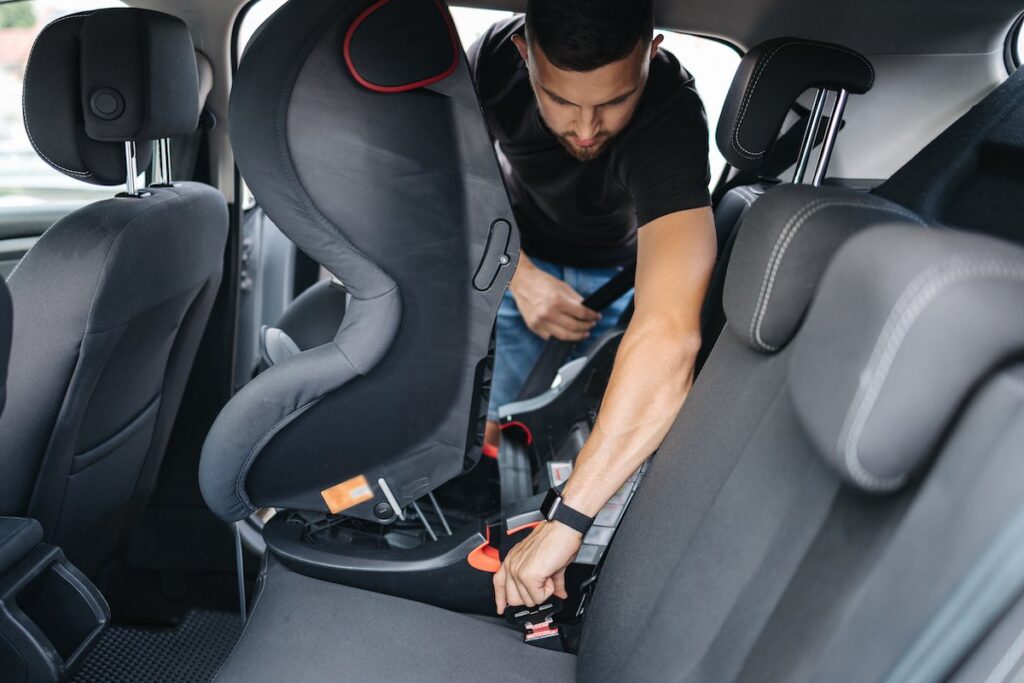
When shopping for a car seat, check its label and instructions for compliance with federal motor vehicle safety standards. Choose a model within your child’s height and weight limits, then install it according to the manufacturer’s directions.
3. Exceptions
Nevada law does not require children to travel in child safety seats on
- public transportation (including taxis),
- school buses, and
- emergency vehicles.
Another exemption is if a car seat would be harmful or impractical for a particular child because of a physical or medical condition. In these cases, though, the driver would need to keep a signed statement from the child’s physician or advanced practice registered nurse in the vehicle.4
Note that the law is unclear re. ridesharing vehicles such as Uber and Lyft. You are advised to bring your own car seat.
4. Penalties
In Nevada, failing to properly secure a child passenger in the proper car seat is a misdemeanor. Penalties for violating NRS 484B.157 get harsher with each successive offense.
A first offense carries $100 to $500 in fines or 10 to 50 hours of community service. However, the judge will waive these requirements as long as you complete a child restraint system training class within 60 days of the sentencing.
A second offense carries $500 to $1,000 in fines or 50 to 100 hours of community service. However, the judge will halve these requirements if both:
- you complete a child restraint system training class within 60 days of the sentencing, and
- you did not have the fine or community service sentence waived for your first offense.
Meanwhile, a third or subsequent offense triggers a driver’s license suspension of 30 to 180 days.
The most important thing is not to ignore your case if you get cited for failing to use a child restraint system. If you miss court, the judge may issue a bench warrant for your arrest.
If you are convicted in Nevada of failing to use child restraints in a vehicle, you can petition for a record seal one year after the case closes. Though if the charge gets dismissed (meaning that there is no conviction), then you can petition for a record seal right away.
At sentencing, the court must provide a list of approved child-restraint training and inspection providers. The list must also state any fee they charge.5
5. Demerit Points
The Nevada Department of Motor Vehicles (DMV) assigns you no demerit points for violating NRS 484B.157 because it is not a moving violation. However, some auto insurance companies may choose to increase premiums.6
6. Defenses
If you are charged with failing to use a child restraint system in Nevada, three potential defenses that may be effective with judges and prosecutors include:
- The police were wrong, and your child was in fact secured by a car seat. The police’s bodycam footage may be sufficient to vindicate you.
- You had a doctor’s note explaining why your child’s condition exempts them from having to be in a child restraint system.
- Your child was too old or too tall to need a child restraint system. Your child’s birth certificate and/or medical records would be useful evidence to prove your child was at least six years old or 57 inches tall.
7. Lawsuits
Drivers who break Nevada child restraint system laws are not automatically deemed negligent or reckless in any ensuing personal injury lawsuits.
Example: Marie is driving her 3-year-old daughter when Rod crashes into them. The daughter was not properly secured in her car seat and sustains serious injuries. If Marie sues Rod for the car accident, Rod cannot use Marie’s violation of the car-seat statute as evidence of negligence. It does not matter that the daughter might have escaped injury had she been secured in the car seat.
Note that Nevada followed the “modified comparative negligence” rule in personal injury cases. This means that you can generally recover damages in an accident as long as you were no more than 50% at fault for the accident: Your ultimate payout would just be reduced by your degree of fault.
Also note that a car seat may be defective because of its design, a manufacturing error, or inadequate safety warnings or instructions. If your child was injured in part due to a defective car seat, you may be able to sue the car seat manufacturer for products liability.
If you suspect the seat failed in a crash, photograph it and keep the seat, packaging, and instructions so its condition can be examined. Do not put a crash-damaged seat back into use: federal safety officials recommend replacing car seats after a moderate or severe crash.7
8. Seat Belts
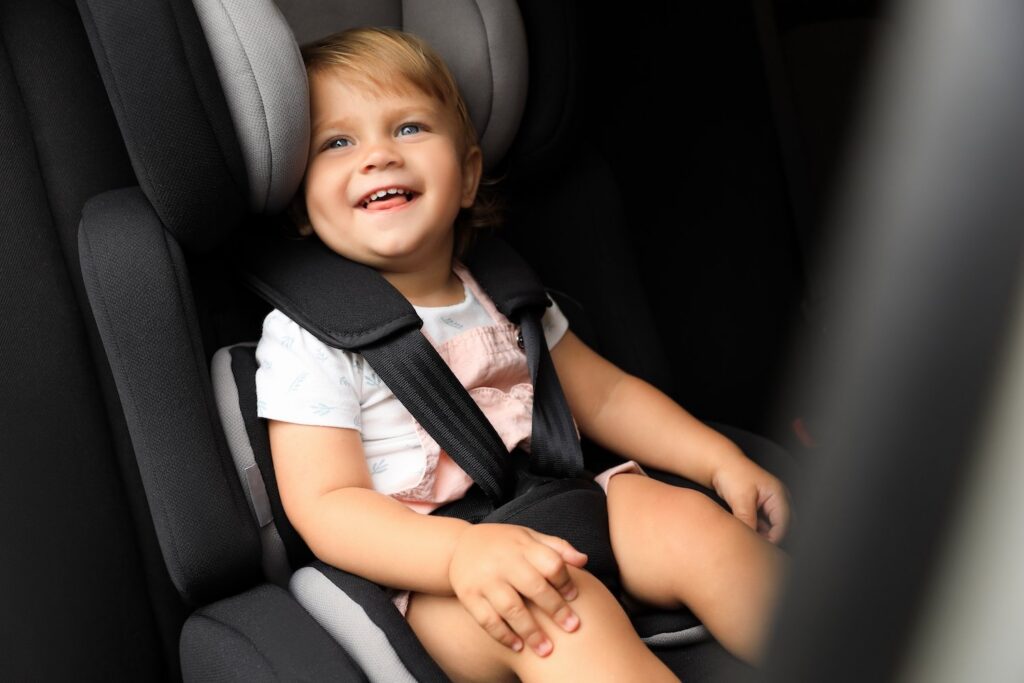
In Nevada, children who outgrow booster seats must wear safety belts in vehicles as adults do. This safety belt requirement lasts for the rest of their lives.
Drivers or passengers who fail to wear safety belts as required face a civil infraction charge. The penalty is a fine of up to $25 or community service. Note that if both the driver and a child passenger(s) are not wearing safety belts, the police officer can issue just one citation for both violations.
Although safety belts are required, Nevada law enforcement officers are not allowed to pull over drivers just because someone is not wearing a safety belt. Instead, the police may issue a safety belt citation only if:
- the vehicle is already stopped, and the police then notice that someone is not wearing a safety belt, and/or
- the driver is being arrested for another (primary) offense.8
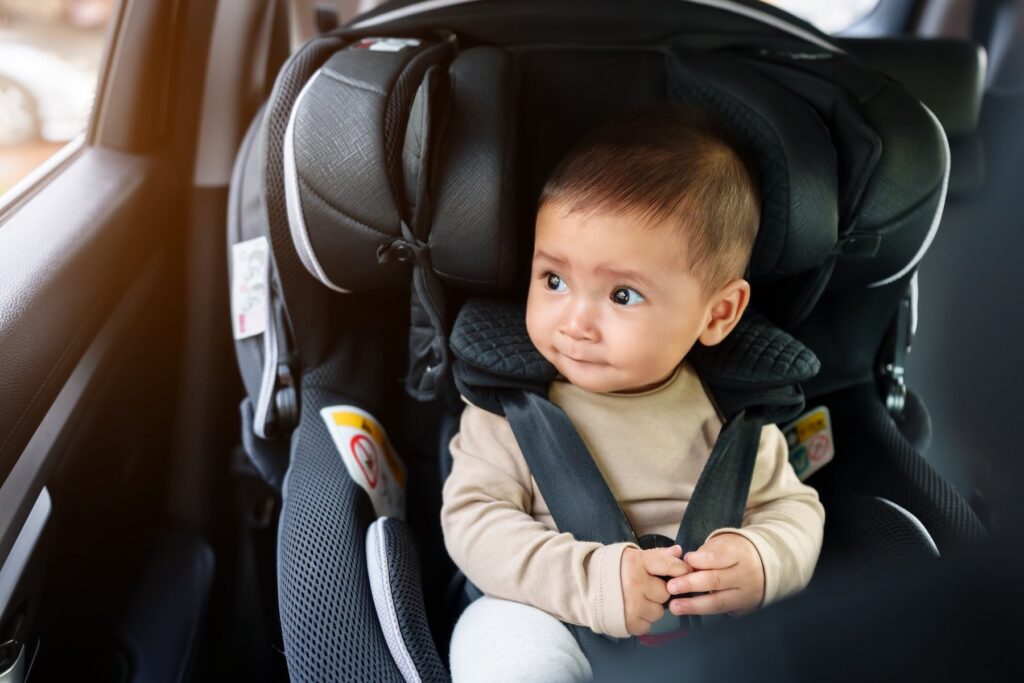
Safety belts typically consist of a shoulder belt and/or a lap belt.
Frequently Asked Questions
Can my child recover compensation after a car crash if they were not in a car seat?
Yes. Nevada law says a violation of its child-restraint statute cannot be considered negligence in a personal injury case. The lack of a car seat does not, by itself, prevent an injured child from seeking compensation from a driver or another party responsible for the crash.
In our experience, the key evidence includes the crash report, witness accounts, medical records, and photographs of the vehicles and child’s injuries. We also look at whether anyone besides the drivers, such as a car-seat manufacturer, may be responsible.
What are Nevada’s basic car seat requirements for children?
Children under 6 years old AND under 57 inches tall must use an approved child restraint system. Children under 2 years must be in a rear-facing car seat in the back seat unless specific medical exemptions or vehicle limitations apply.
If medical exemptions do apply to your child, we recommend having written doctor’s notes with you in the vehicle. That way you can show the police if they try to cite you for an NRS 484B.157 violation.
What are the penalties for violating Nevada’s car seat laws?
First offense: $100 to $500 in fines or 10 to 50 hours of community service (can be waived with training).
Second offense: $500 to $1000 in fines or 50 to 100 hours of community service (can be reduced by half with training if there was no waiver with the first offense).
Third offense: 30 to 180-day driver’s license suspension.
Are there any exceptions to Nevada’s car seat laws?
Yes, exceptions include public transportation, school buses, emergency vehicles, and cases where a physician provides written documentation that car seats would be harmful/impractical for a child’s medical condition.
Always keep any doctor’s notes exempting your child from the car seat rules in your vehicle. If a policeman stops you, these notes may keep you from getting cited.
When can my child switch from a car seat to regular seat belts?
Children can switch to regular seat belts when they are at least 6 years old or 57 inches tall. However, it’s recommended that children stay in appropriate restraint systems until they can properly fit in regular seat belts.
It is recommended that preteen passengers remain in the back seat.

Additional Resources
For more information related to car seat laws, refer to the following:
- Nevada State Police Office of Traffic Safety: Information on state car seat laws and recent recalls
- Safe Kids Worldwide – Nevada: Overview of Nevada car seat regulations with links to other states’ laws
- Zero Fatalities – Nevada’s traffic safety program with the aim of eliminating all traffic deaths and serious injuries on Nevada roadways.
- Vegas Family Guide – Information on how to get free car seat safety checks.
- National Highway Traffic Safety Administration – Car Seats and Booster Seats: General information on car seats and how to install them correctly
- American Academy of Pediatrics – Car Seat Safety: Discussion of how to safely restrain small children during car rides
- Centers for Disease Control and Prevention – Child Passenger Safety: Get the Facts: Statistics on child deaths due to motor vehicle crashes
Legal References
- NRS 484B.157 – Child less than 6 years of age and less than 57 inches tall to be secured in child restraint system while being transported in motor vehicle; child less than 2 years of age to be secured in rear-facing child restraint system in back seat with certain exceptions; requirements for system; penalties; programs of training; waiver or reduction of penalty under certain circumstances; application of section; acceptance of gifts, grants and donations for purchase of child restraint systems.
1. Except as otherwise provided in subsection 7, any person who is transporting:
(a) A child who is less than 6 years of age and less than 57 inches tall in a motor vehicle operated in this State which is equipped to carry passengers shall secure the child in a child restraint system which:
(1) Has been approved by the United States Department of Transportation in accordance with the Federal Motor Vehicle Safety Standards set forth in 49 C.F.R. Part 571;
(2) Is appropriate for the size and weight of the child; and
(3) Is installed within and attached safely and securely to the motor vehicle:
(I) In accordance with the instructions for installation and attachment provided by the manufacturer of the child restraint system; or
(II) In another manner that is approved by the National Highway Traffic Safety Administration.
(b) A child who is less than 2 years of age in a motor vehicle operated in this State which is equipped to carry passengers shall secure the child in a rear-facing child restraint system in the back seat of the motor vehicle in accordance with subparagraphs (1), (2) and (3) of paragraph (a) unless the child is secured in a rear-facing child restraint system on the passenger side of the front seat in accordance with subparagraphs (1), (2) and (3) of paragraph (a), the air bag on the passenger’s side of the front seat, if any, is deactivated and:
(1) Special health care needs of the child require the child to ride in the front seat of the motor vehicle and a written statement signed by a physician certifying the requirement is carried in the motor vehicle;
(2) All back seats in the motor vehicle are in use by other children who are less than 2 years of age; or
(3) The motor vehicle is not equipped with back seats.
2. A person who violates the provisions of subsection 1 is guilty of a misdemeanor and the court shall:
(a) For a first offense, order the person to pay a fine of not less than $100 or more than $500 or order the person to perform not less than 10 hours or more than 50 hours of community service;
(b) For a second offense, order the person to pay a fine of not less than $500 or more than $1,000 or order the person to perform not less than 50 hours or more than 100 hours of community service; and
(c) For a third or subsequent offense, suspend the driver’s license of the person for not less than 30 days or more than 180 days.
3. At the time of sentencing, the court shall provide the person who committed the offense with a list of persons and agencies approved by the Department of Public Safety to conduct programs of training and perform inspections of child restraint systems. The list must include, without limitation, an indication of the fee, if any, established by the person or agency pursuant to subsection 4. If, within 60 days after sentencing, the person provides the court with proof of satisfactory completion of a program of training provided for in this subsection, the court shall:
(a) If the person was sentenced pursuant to paragraph (a) of subsection 2, waive the fine or community service previously imposed; or
(b) If the person was sentenced pursuant to paragraph (b) of subsection 2, reduce by one-half the fine or community service previously imposed.
-> A person is only eligible for a reduction of a fine or community service pursuant to paragraph (b) if the person has not had a fine or community service waived pursuant to paragraph (a).
4. A person or agency approved by the Department of Public Safety to conduct programs of training and perform inspections of child restraint systems may, in cooperation with the Department of Motor Vehicles, establish a fee to be paid by persons who are ordered to complete a program of training. The amount of the fee, if any:
(a) Must be reasonable; and
(b) May, if a person desires to acquire a child restraint system from such a person or agency, include the cost of a child restraint system provided by the person or agency to the defendant.
-> A program of training may not be operated for profit.
5. For the purposes of NRS 483.473, a violation of this section is not a moving traffic violation.
6. A violation of this section may not be considered:
(a) Negligence in any civil action; or
(b) Negligence or reckless driving for the purposes of NRS 484B.653.
7. This section does not apply:
(a) To a person who is transporting a child in a means of public transportation, including a taxi, school bus or emergency vehicle.
(b) When a physician or an advanced practice registered nurse determines that the use of such a child restraint system for the particular child would be impractical or dangerous because of such factors as the child’s weight, physical unfitness or medical condition. In this case, the person transporting the child shall carry in the vehicle the signed statement of the physician or advanced practice registered nurse to that effect.
8. The Department of Public Safety may accept gifts, grants and donations from any source for the purpose of the purchase or donation of child restraint systems for persons who are in financial need.
9. As used in this section, “child restraint system” means any device that is designed for use in a motor vehicle to restrain, seat or position children. The term includes, without limitation:
(a) Booster seats and belt-positioning seats that are designed to elevate or otherwise position a child so as to allow the child to be secured with a safety belt;
(b) Integrated child seats; and
(c) Safety belts that are designed specifically to be adjusted to accommodate children.
- NHTSA Recommendations for Children; see also AAP Updates Car Safety Seat Recommendations for Children, American Academy of Pediatrics (September 21, 2018); Occupant Protection / Child Passenger Safety, Department of Public Safety; see also Nevada Department of Transportation. See also Buckle Up, Nevada DMV.
- Nevada Revised Statute 484B.157.
- Same.
- Same. NRS 179.245. NRS 179.255.
- See note 3.
- Same.
- NRS 484D.495; see Cortes v. State (Nev. 2011) 260 P.3d 184. Note that the following people are exempted from NRS 484D.495(2) and (3): Drivers or passengers with a doctor’s note certifying that they cannot wear seat belts due to medical/physical reasons; people in vehicles not required under federal law to have seat belts; USPS workers in rural Nevada; people in vehicles who frequently exit the vehicle or delivery property from the vehicle, and the vehicle is stopping often and never exceeds 15 mph between stops; and public transportation passengers (such as in emergency vehicles or school buses but not taxis).